
Table of Contents
- What Is Knob and Tube Wiring and Why It Matters Today
- Why Knob and Tube Wiring Is Dangerous: The Core Safety Issues
- Signs of Unsafe Knob-and-Tube Wiring You Should Know
- Knob-and-Tube Wiring Inspection: What to Expect
- Knob-and-Tube Wiring Home Insurance: Coverage and Requirements
- Knob-and-Tube Wiring Replacement Cost and Your Options
- Should You Buy a House with Knob and Tube Wiring?
- Next Steps: Getting Your Electrical System Assessed
- Frequently Asked Questions
Last Updated: October 7, 2026
What Is Knob and Tube Wiring and Why It Matters Today
Knob and tube wiring dangerous is a reality: it’s an outdated electrical system common in homes built before the 1950s.
If your home was built in the early-to-mid 20th century, you may still have knob and tube wiring.
It impacts your home’s safety, resale value, and insurance eligibility. Many insurers refuse to cover homes with active knob and tube systems, and lenders often require replacement before financing.
Why Knob and Tube Wiring Is Dangerous: The Core Safety Issues
Knob and tube wiring dangerous is not an exaggeration, it’s a documented electrical hazard with three core problems.
Electrical Fire Risk and Overheating
The original design assumed minimal load, a typical 1920s house had 30-40 amps of service, while today’s average home uses 100-200 amps.
Overheating degrades insulation: rubber and cloth become brittle and crack, and exposed copper creates short circuits and sparking, how electrical fires start.
Common warning signs include:
- Outlets that feel warm to the touch
- A burning smell near outlets or walls
- Flickering lights when appliances turn on
If you notice any of these, call a licensed electrical contractor immediately.
Lack of Grounding Conductors
Modern code requires three wires: hot, neutral, and ground. The ground wire provides a safe path for electricity if something goes wrong.
Knob and tube systems only have two wires: hot and neutral. No ground wire means no shock protection, no safe path for fault current, and increased risk when the system overloads, a fundamental safety gap modern code exists to prevent.
Incompatibility with Modern Electrical Loads
Your EV charger, heat pump, and modern kitchen appliances draw power knob and tube wiring cannot safely handle. It was designed for light bulbs and small appliances, not high-amperage or continuous-duty loads. Exceed its capacity and wires overheat, insulation cracks, and fires can start inside walls where you cannot see them.
Signs of Unsafe Knob-and-Tube Wiring You Should Know
Identifying knob and tube wiring requires knowing what to look for.
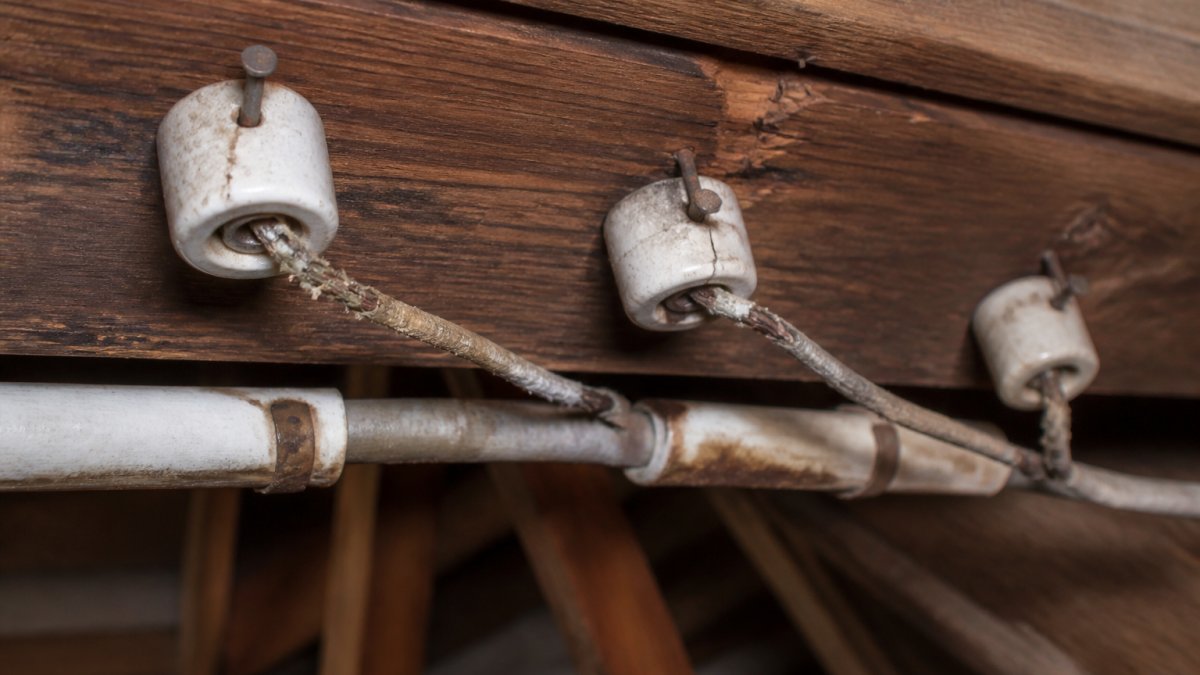
Porcelain knobs and ceramic tubes are the most obvious signs. Look in your attic, basement, or crawl space.
Insulation condition matters greatly. New knob and tube wiring has intact rubber or cloth insulation.
Check for mixed wiring systems. Many homes have had partial updates, so you might see knob and tube in some areas and modern Romex cable in others, some areas are safer than others.
Outlet and switch appearance can hint at the underlying wiring.
Knob-and-Tube Wiring Inspection: What to Expect
Visual assessment comes first: an electrician examines accessible areas, attic, basement, crawl space, and behind outlet plates, photographing the wiring, noting insulation condition, and checking for overheating or damage.
Testing and documentation follow: the electrician tests amperage capacity, checks grounding, and identifies how much of your home still uses the original system.
The inspection takes 1-3 hours depending on size and accessibility, and you receive a written report with photos and recommendations.
Knob-and-Tube Wiring Home Insurance: Coverage and Requirements
What matters is how carriers evaluate the risk, what they ask for, and how you move a policy from declined to bound.
How Underwriters Actually Classify Knob and Tube
Carriers rarely treat “knob and tube” as a single yes/no flag. They split it into three buckets:
- Active, in-service K&T on energized branch circuits. Highest risk. Many standard carriers won’t write a new policy, and several will non-renew an existing one once an inspection or claim surfaces it.
- De-energized but still present. The wiring is in the walls but disconnected from the panel. Most carriers treat this as a disclosure item rather than a declination, though some want a removal timeline.
- Partially remediated. K&T remains on low-demand circuits (typically lighting or a single bedroom) while kitchen, bath, laundry, and HVAC circuits have been rewired. This is where negotiation happens.
Your goal in an underwriting conversation is not to argue that K&T is “probably fine.” It’s to move your file from bucket one to bucket three with documentation, or to bucket two with a signed electrician’s letter.
What Carriers Typically Ask For
Requirements vary by carrier and state, but a common pattern includes:
- A licensed electrician‘s inspection letter on company letterhead, signed and dated, stating the extent of remaining K&T, insulation condition, and whether any circuits show signs of overheating.
- Photographs of the panel, the K&T runs in accessible spaces, and any spliced or junction areas.
- A remediation plan with dates, a written schedule, not a promise to rewire “eventually.” Carriers frequently accept 12- to 24-month windows for full replacement.
- Proof of completed work, a final inspection sign-off or a contractor’s invoice with permit number, at renewal.
Without item one, you usually can’t get to items two through four. The inspection letter is the gate.
The Documentation Packet That Gets Policies Bound
A packet that works with underwriters includes:
- Electrician’s license number and state of issuance
- Date of inspection and the address inspected
- A plain-language statement of what percentage of branch circuits remain on K&T
Ask your electrician to write this as a standalone letter, not a line item buried in a general home inspection report. Underwriters read letters; they skim reports.
Negotiating With an Underwriter
A few practical moves that change outcomes:
- Ask for the specific guideline, not a yes/no. “Which underwriting guideline does this property fail?” gets you a rule you can address; “Will you cover it?” gets you a no.
- Offer a higher deductible on the electrical peril if the carrier allows it, a legitimate lever.
- Escalate to a broker who writes high-risk or surplus-lines business. Standard carriers decline; surplus-lines carriers price. The premium is higher, but the policy exists, which is what your lender needs.
Failing to disclose known knob and tube wiring on an application is material misrepresentation. If a fire occurs and the carrier can show you knew, the claim can be denied even if the fire had nothing to do with the wiring. Disclose it, then negotiate.
What Changes After Rewiring
Once a licensed electrician completes the rewire and the work passes inspection, most carriers move the property back to standard rating at the next renewal. Keep the permit, final inspection sign-off, and contractor’s invoice together, you’ll be asked for all three. If you switch carriers, the new application will ask whether K&T was ever present; answer yes, with documentation showing it was removed.
state insurance department consumer complaint and carrier lookup
Knob-and-Tube Wiring Replacement Cost and Your Options
Here’s the framework electricians use to decide between a partial upgrade and a full rewire.
The Three Real Options
1. Full rewire. Every branch circuit is replaced with modern cable, and the panel is typically upgraded at the same time.
2. Partial rewire (targeted circuits). High-demand and wet-location circuits, kitchen, bathrooms, laundry, garage, HVAC, and any circuit feeding a large appliance, move to modern wiring, leaving K&T only on lighting and low-draw receptacle circuits.
3. De-energize and abandon in place. The K&T is disconnected at the panel and left in the walls.
When Partial Is Defensible, and When It Isn’t
Partial rewiring is defensible when: remaining K&T circuits carry only lighting or low-draw loads; insulation is intact with no cracking, discoloration, or past overheating; no K&T run is buried in thermal insulation (see the code note below); the panel has adequate capacity and modern overcurrent protection; and the homeowner budgets for eventual replacement.
It is not defensible when: K&T runs through cavities filled with blown-in insulation; any circuit shows warm outlets, discolored insulation, or tripped breakers; aluminum branch wiring is mixed in; the panel is a fuse box or early breaker panel with no replacement parts; or the lender or insurer requires full removal.
Partial rewiring is a risk-reduction step, not a permanent solution. Treat it as a phase-one of a two-phase plan, and put the phase-two date on paper for your insurer.
The Code Trigger Most Homeowners Miss
The National Electrical Code prohibits installing thermal insulation in direct contact with knob and tube wiring, because the wiring was designed to dissipate heat into open air. When a cavity containing K&T is later insulated, exactly what weatherization programs do, the wiring loses its heat path and fire risk rises sharply. A home that was “fine” with K&T for decades can become materially more dangerous after a single insulation upgrade, so the insulation contractor and electrician need to be coordinated.
What Drives the Cost
The number is set by five variables, in order of impact:
- Square footage and circuit count. More rooms, more circuits, more wire.
- Wall and ceiling construction. Open attic and unfinished basement access keeps cost down; finished plaster walls push it up because walls must be opened and repaired.
- Panel and service upgrade. A 200-amp service upgrade is a separate scope, priced separately.
- Permits and inspection. Fees and scheduling vary by jurisdiction and are usually passed through.
- Restoration. Drywall repair, plaster patching, and painting are frequently excluded from electrical quotes and can rival the electrical cost in a finished home.
Because these variables swing so widely, any national “average” figure online is a starting point for a conversation, not a budget. Get at least three itemized quotes separating electrical work, panel work, permits, and restoration.
Questions to Ask Every Contractor
- Is the quote based on a physical inspection of the attic, basement, and panel, or on square footage alone?
- Does the scope include the service panel, or is that a separate line item?
- Are permits pulled in the contractor’s name, and is the final inspection included?
A quote that is dramatically lower than the others usually means one of three things: no permit, no panel work, or no restoration. Ask which one, and get the answer in writing before you sign.
Should You Buy a House with Knob and Tube Wiring?
The financial reality: Replacing knob and tube wiring is an expense, but not a dealbreaker if the price reflects the work.
The insurance problem is real. Before making an offer, ask insurers about coverage.
Inspection is non-negotiable. Never buy a home with knob and tube wiring without a professional electrical inspection.
The key is information: know the true cost of replacement before you commit, then decide if the property is worth it at that price.
Next Steps: Getting Your Electrical System Assessed
If you suspect your home has knob and tube wiring, the first step is a professional assessment, facts instead of guesses.
Contact a licensed electrician. Look for experience with older homes and knob and tube systems, ask for references, and verify their license and insurance.
Get multiple quotes if replacement is necessary. Compare not just price but scope of work and timeline.
Plan your budget. Whether you rewire now or later, start setting aside funds.
At Fox Electric Technologies, we provide honest assessments, transparent pricing, and professional work that meets all current electrical codes.
Frequently Asked Questions
Can you insure a house with knob and tube wiring?
Most homeowner insurance carriers will not issue or renew policies on homes with active knob and tube wiring systems. Some insurers may provide temporary coverage while you arrange replacement, but many require full rewiring before they’ll underwrite the property. Contact your insurance provider directly, requirements vary by carrier and your local jurisdiction. This is one of the most significant financial implications of owning a home with this wiring.
What are the main signs of unsafe knob-and-tube wiring?
Look for cracked or missing porcelain knobs, frayed or discolored insulation around the wires, charred ceramic tubes, and visible corrosion. If you see cloth or rubber wrapping instead of modern plastic sheathing, or notice a burning smell near outlets, that’s a red flag. An electrical inspector can confirm the system’s condition and identify degraded insulation that poses fire hazards.
Is it illegal to sell a house with knob and tube wiring?
It’s not universally illegal to sell a house with knob and tube wiring, but disclosure laws require you to inform buyers. Many jurisdictions require inspection and may mandate replacement before closing. Some lenders won’t finance properties with active knob and tube systems. Check your local building codes and consult a real estate attorney, regulations vary by location.
How much does knob-and-tube wiring replacement typically cost?
Replacement costs depend on your home’s size, the extent of rewiring needed, and local labor rates. A partial rewire for specific circuits costs less than a full system replacement. For an accurate estimate tailored to your home, contact a licensed electrical contractor for a professional assessment. Fox Electric Technologies offers free estimates to help you understand the scope and investment required.
Your home’s electrical system is the foundation of everything else. Knob and tube wiring is a known hazard that insurance companies, lenders, and building codes all recognize as unsafe. Taking action now protects your family, preserves your home’s value, and gives you peace of mind. Contact Fox Electric Technologies for a professional assessment and let’s make sure your electrical system is safe.
