
Last Updated: November 15, 2026
Quick Summary
What to do when electrical outlets feel warm to touch: stop using the outlet and unplug everything immediately, then let it cool for at least 30 minutes and check whether it stays warm with nothing connected. If it remains warm or any warning sign appears, turn off the breaker and call a licensed electrician.
- A standard outlet should feel room temperature; only devices like dimmers may give off slight warmth.
- Unplug devices from a warm outlet right away to cut electrical demand and heat buildup.
- Wait at least 30 minutes with nothing plugged in, then touch the faceplate again.
- A space heater or portable air conditioner draws 8 to 9 amps and can heat a shared circuit.
- Turn off the breaker before any further inspection, and never skip this step.
Table of Contents
- Why an Electrical Outlet Feels Warm and Why It Matters
- Emergency Triage: Warning Signs That Need Immediate Action
- Step-by-Step: What to Do When an Outlet Is Warm to the Touch
- Why Is My Outlet Warm With Nothing Plugged In?
- Signs of Faulty Electrical Wiring Behind the Wall
- GFCI Outlet Warm to Touch: What It Means
- When to Replace an Electrical Outlet
- Schedule a Professional Electrical Inspection With Fox Electric Technologies
- Frequently Asked Questions
Why an Electrical Outlet Feels Warm and Why It Matters
Knowing what to do when electrical outlets feel warm to touch starts with one fact: a warm outlet is a warning. Standard electrical outlets should not feel warm to the touch, according to Leviton’s outlet safety guidance.
Heat comes from resistance. When current flows through a loose wire connection, the gap creates friction, and friction creates heat.
This matters because heat is the first stage of an electrical fire. It builds behind the wall, out of sight, long before you smell anything.
Normal Warmth vs. a Warning Sign
The difference is simple. A dimmer switch may feel slightly warm. A standard outlet should feel room temperature.
If an outlet feels warm, treat it as a fault until proven otherwise. Homeowners often assume a little heat is fine during heavy use, but safety professionals disagree.
Watch out: a warm outlet that cools down after you unplug a device is still a red flag. The heat revealed a weak point in the circuit.
Emergency Triage: Warning Signs That Need Immediate Action
Stop and act now if you see any of these signs. They point to an active fire risk, not a future one.
- Burning smell near the outlet or faceplate
- Scorch marks or brown discoloration around the slots
- Sparks when you plug in or unplug a device
For any of these, cut power at the breaker, leave the area, and call for help.
If you are unsure how urgent your situation is, our guide to emergency electrical repair services explains how the process works and how to get help fast.
Step-by-Step: What to Do When an Outlet Is Warm to the Touch
Here is what to do when electrical outlets feel warm to touch but show no emergency signs. Follow the steps in order, and stop at any point where you feel unsure.
- Stop using the outlet. Unplug everything from it right away. A May 2026 Mr. Sparky safety article recommends unplugging devices from a warm outlet to cut electrical demand and heat buildup.
- Let it cool. Wait at least 30 minutes with nothing plugged in. Then touch the faceplate again. If it is still warm with nothing connected, the heat is coming from behind the wall, not from a device.
- Check what was plugged in. A space heater or portable air conditioner draws 8 to 9 amps, according to Stack Exchange electrical discussion. That load can heat a daisy-chained outlet on a shared circuit. Note whether the device has a damaged cord, a loose plug, or a plug that fits loosely in the slots.
- Feel the other outlets on the same circuit. If several are warm, the problem is the circuit, not one receptacle. If only one is warm, suspect that receptacle’s connections or the device that was plugged into it.
- Look at the faceplate. Discoloration, cracks, or a loose fit mean the outlet needs replacement. A faceplate that is warm to the touch but not hot is still a fault signal, not normal operation.
- Turn off the breaker before any further inspection. Never skip this step. See the breaker-identification guidance below before you touch the panel.
- Call a licensed electrician if the outlet stays warm with nothing plugged in, or if any warning sign appears.
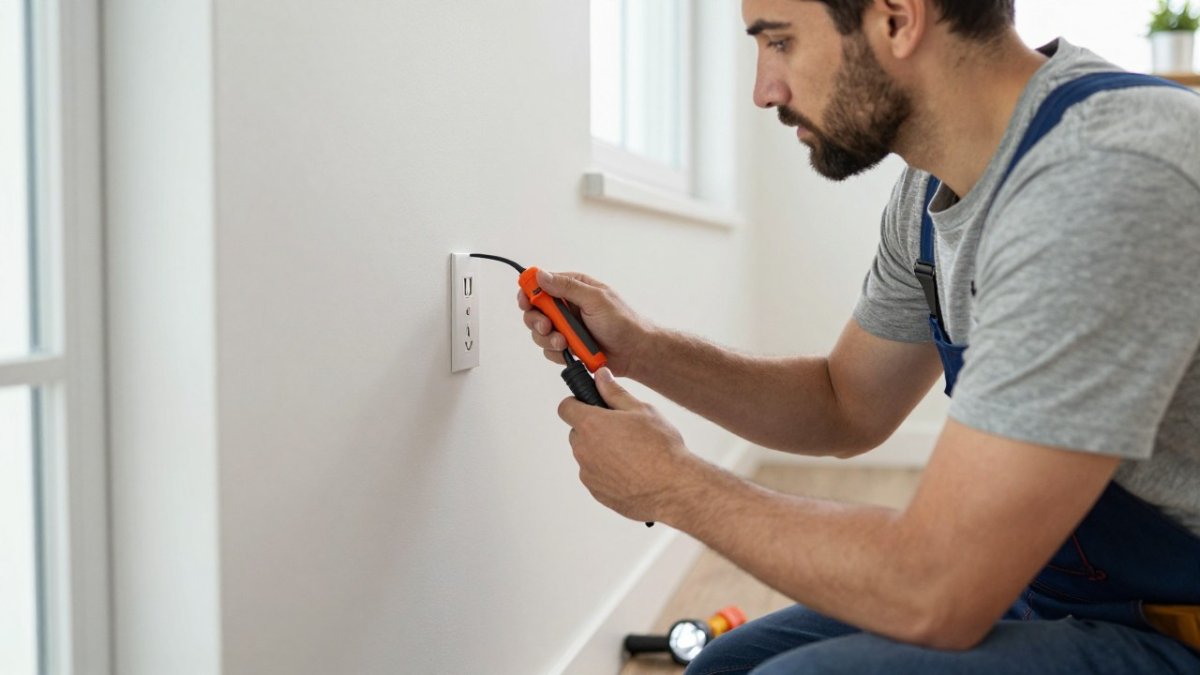
If the outlet needs repair or replacement, you can get electric repair in Los Angeles from our certified team.
What You Can Safely Do Yourself, and Where to Stop
Unplugging devices and switching off the breaker are the two actions a homeowner can take without electrical training. Everything past that point belongs to a licensed electrician.
- Safe: unplug cords, switch the breaker off, test the outlet with a plug-in tester or lamp, label the breaker, and keep the outlet out of service until it is inspected.
- Not safe: removing the cover plate, pulling the receptacle out of the box, touching terminals or wiring, replacing the outlet yourself if you are unsure how to verify power is off, or resetting a breaker repeatedly to “see if it holds.”
Watch out: a breaker that trips again immediately after you reset it is telling you the fault is still present. Do not keep resetting it; leave it off and call an electrician.
How to Identify the Correct Circuit and Verify Power Is Off
Never trust a switch or a breaker label. Test the outlet itself.
- Plug a lamp or outlet tester into the receptacle.
- Flip breakers one at a time until the tester goes dark.
- Label that breaker clearly for next time.
A non-contact voltage tester held near the faceplate is a quick check, but it can read phantom voltage on some circuits. A plug-in tester or a lamp is the more reliable confirmation that the receptacle is actually dead. If the tester still lights after you have flipped every single-pole breaker, stop and call an electrician; the panel may have a tandem or a mislabeled circuit you should not chase on your own.
Does Outlet Type or Location Change the Response?
The short answer is no for the immediate steps and yes for the follow-up.
- GFCI outlets in kitchens, bathrooms, garages, and outdoors protect against shock, not heat. A warm GFCI gets the same stop-use response, plus a check of whether it will reset and whether it is more than 10 to 15 years old.
- Outlets serving high-load appliances such as a microwave, space heater, or window air conditioner are the most common source of device-driven warmth. Move the load to a dedicated circuit if one is available.
- Outlets near moisture deserve extra caution because a warm receptacle plus a damp location raises the shock risk. Keep the outlet out of service until it is inspected.
If the outlet needs repair or replacement, you can get electric repair in Los Angeles from our certified team.
Here is the order of steps to follow when an outlet is warm but shows no emergency signs.
| Step | What to do | Key detail |
|---|---|---|
| 1 | Stop using the outlet | Unplug everything right away |
| 2 | Let it cool | Wait at least 30 minutes, then touch faceplate |
| 3 | Check what was plugged in | Space heater or AC draws 8 to 9 amps |
| 4 | Feel other outlets on the circuit | Several warm means circuit problem |
| 5 | Look at the faceplate | Discoloration, cracks, or loose fit mean replacement |
| 6 | Turn off the breaker | Never skip this step |
| 7 | Call a licensed electrician | If warm with nothing plugged in or warning signs appear |
Why Is My Outlet Warm With Nothing Plugged In?
An outlet that is warm with nothing plugged in is the most serious version of this problem.
The usual cause is a loose connection at the electrical terminals behind the faceplate. Current arcs across the gap, and the connection heats up.
This is not a wait-and-see situation. A breaker that trips on the same circuit is another clue; our guide on why circuit breakers trip explains what repeated trips signal.
Signs of Faulty Electrical Wiring Behind the Wall
Some warning signs show up away from the outlet. Look for these across your home:
- Outlets that feel warm in more than one room
- Lights that flicker or dim when an appliance starts
- A faint burning smell with no visible source
Any one of these points to wiring that needs professional review. If the wiring behind your walls is damaged or outdated, a rewire in Los Angeles may be the right next step.
GFCI Outlet Warm to Touch: What It Means
A GFCI outlet that feels warm needs the same response as any other receptacle: stop using it, unplug everything, and have it inspected. GFCIs protect against shock in kitchens, bathrooms, garages, laundry rooms, and outdoor locations.
Warmth at a GFCI usually points to one of four things:
- An overloaded circuit. GFCIs are often installed on shared circuits that also feed other receptacles. A space heater or hair dryer on the same circuit can heat the GFCI’s internal components along with the wiring.
- A loose wire connection. The line and load terminals on a GFCI carry the full downstream load. A back-stabbed or loosened connection at those terminals is a common heat source.
- A failing device. GFCIs have a finite service life. GFCI devices have a finite service life, and units in humid locations tend to fail sooner. A GFCI that is warm, will not reset, or trips without a fault should be evaluated for replacement.
Watch out: a GFCI that trips every time you reset it, or that will not reset at all, may have failed internally. Do not assume the circuit is safe just because the outlet is dead; the failure could be in the sensing circuit while the wiring behind it is still compromised.
How GFCI Warmth Differs From a Standard Outlet
A standard receptacle has no electronics inside, so any warmth there comes from the wiring or the plug connection. A GFCI contains a sensing circuit and a trip mechanism, which adds two more possible heat sources: the internal electronics and the load terminals that feed downstream outlets.
If the GFCI is warm and the downstream outlets on the same circuit are also warm, the problem is likely the circuit load or a shared connection. If only the GFCI is warm, suspect the device or its terminals.
What to Do Next
Stop using the GFCI and unplug anything connected to it or to outlets downstream of it. Switch the breaker off, label it, and leave the outlet out of service.
Call a licensed electrician if the GFCI stays warm with nothing plugged in, will not reset, trips repeatedly, or shows any discoloration or burning smell. Replacement is a small job, but verifying that the line and load terminals are correct and that the downstream protection is intact is not a DIY task for most homeowners.
When to Replace an Electrical Outlet
Replace an outlet when it shows physical damage or will not hold a plug securely. Loose slots, cracks, discoloration, and scorch marks are all replacement signals.
Age matters too. Outlets wear out after years of use and heavy loads. A receptacle that has overheated once is weaker than it was before.
- Faceplate cracked, discolored, or loose
- Plug falls out or fits loosely
- Outlet feels warm with nothing plugged in
Replacement is a small job with a big safety payoff.
Schedule a Professional Electrical Inspection With Fox Electric Technologies
A warm outlet is a small symptom with many causes. Only an inspection can tell you which one you have.
At Fox Electric Technologies, we deliver safe, code-compliant work.
Do not wait for a warm outlet to become a fire. Contact our team to schedule your inspection and get a free estimate.
A warm outlet will not fix itself, and the risk grows with every hour of use.
Frequently Asked Questions
Why does my wall outlet feel hot to the touch?
Heat at an outlet comes from electrical resistance somewhere in the circuit. The usual culprits are loose wiring at the terminals, an overloaded circuit carrying more current than it was designed for, or a failing device plugged into the receptacle. Standard outlets should not feel warm at all, even under load. If the faceplate is hot, discolored, or you smell burning, stop using the outlet and call a licensed electrician.
Is it normal for an electrical plug to get warm?
A plug can feel slightly warm during heavy use, but it should never be hot. Moderate power devices like space heaters or portable air conditioners draw 8 to 9 amps, and daisy-chained outlets on the same circuit can build heat under that demand. If the plug itself is hot, the prongs look scorched, or the receptacle is warm with nothing plugged in, treat it as a fault and have the circuit inspected.
Can a warm outlet lead to an electrical fire?
Yes. Loose wiring is one of the leading causes of heat buildup in residential electrical systems, and sustained heat at a connection is a fire hazard. The risk rises sharply when you see scorch marks, smell burning, or hear buzzing or crackling at the outlet. Turn off the breaker, unplug devices, stop using the outlet, and get a licensed electrician to inspect the wiring before the circuit goes back into service.
When should I call an electrician for a warm outlet?
Call immediately if the outlet is hot, discolored, buzzing, sparking, or smoking, or if anything plugged in smells like burning. Also call if the outlet stays warm with nothing plugged in, if the breaker trips repeatedly, or if you find signs of faulty electrical wiring such as a dead outlet nearby. A licensed electrician can verify the circuit, check the terminals, and replace the receptacle or repair the wiring.

