
Last Updated: November 17, 2026
Quick Summary
An overloaded panel is a breaker box carrying more electrical demand than its rated capacity can safely handle, so breakers trip, wires heat up, and the risk of fire climbs. It warns you first with repeated trips, dimming lights, a warm cover, buzzing, or a burning smell. Stop using affected circuits and call a licensed electrician.
- A breaker that trips again and again under normal use is the clearest sign of an overloaded panel.
- Never open the panel cover yourself, because service conductors stay live with the main breaker off.
- A 100-amp panel provides about 24,000 watts of capacity for your load comparison.
- A breaker should carry no more than 80% of its rating for continuous loads.
- Call an electrician if the same breaker trips more than twice a month or the panel is warm or buzzing.
Table of Contents
- What Happens When a Panel Is Overloaded
- Signs of an Overloaded Electrical Panel
- How to Determine Electrical Panel Capacity
- How to Calculate Electrical Panel Load
- Tandem Breakers and the 80% Rule
- Overload vs. Other Electrical Faults
- When to Call a Licensed Electrician
- Request a Free Estimate from Fox Electric Technologies
- Frequently Asked Questions
What Happens When a Panel Is Overloaded
The short answer: the panel does not fail all at once. It warns you first.
A breaker trips. Lights dim when the dryer kicks on. The panel cover feels warm. Each of those is the system telling you the load has outgrown the service capacity.
Most homeowners ignore those signals until something breaks. A tripped breaker gets reset, the flickering light gets a new bulb, and the real problem stays hidden behind the panel door.
Below, we break down the warning signs, how panel capacity is measured, and when it is time to call a licensed electrician.
Signs of an Overloaded Electrical Panel
The clearest sign of an overloaded electrical panel is a breaker that trips again and again under normal use. One trip is routine. The same breaker tripping every week is not.
Other signs of an overloaded electrical panel include:
- Lights that flicker or dim when a large appliance starts
- A panel cover that feels warm to the touch
- A faint buzzing sound near the breaker panel
- A burning smell with no obvious source
- Breakers that trip when several appliances run at once
- Scorched or discolored spots around breakers
- Appliances that shut off on their own
Any single sign deserves attention. Two or more together point to a real capacity problem.
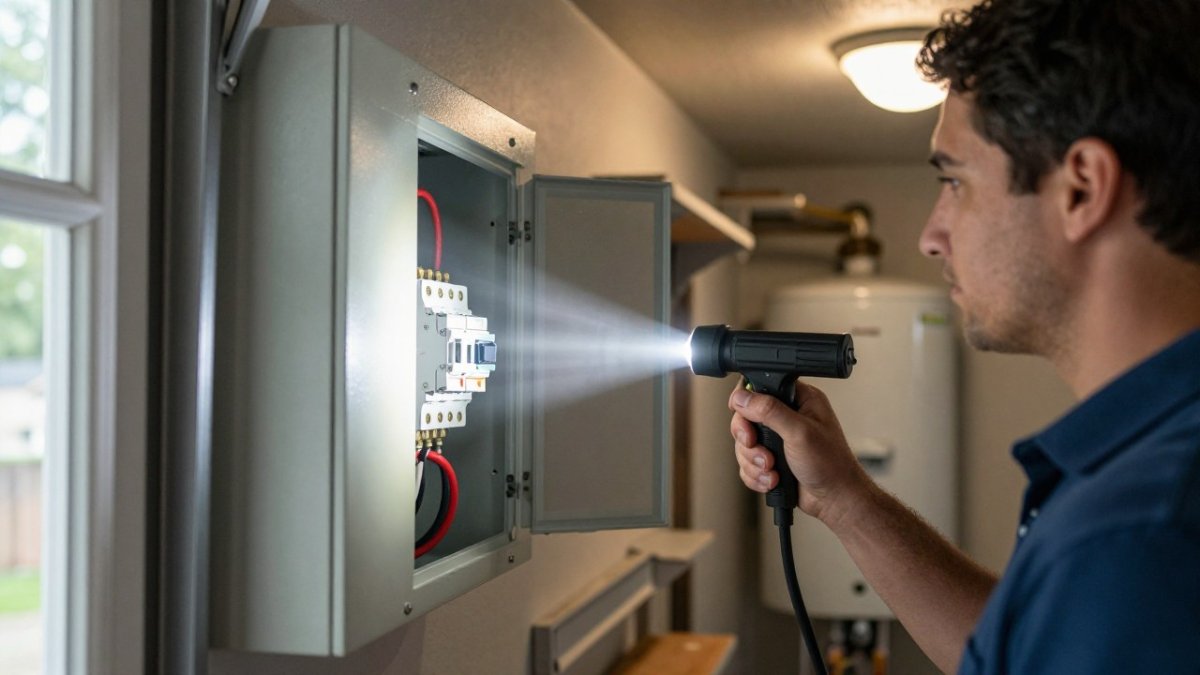
Frequent Breaker Trips and Power Interruptions
A breaker trips because it is doing its job. It cuts power when current exceeds the breaker rating, which protects the wiring from overheating.
Frequent trips mean the circuit is drawing more than it can carry. The panel is not broken; the electrical load is too high for that circuit.
Sometimes the fix is simple: move a high-demand appliance to another circuit. But if trips keep happening across several circuits, the panel itself may be undersized, and a load calculation is the way to confirm it. Repeated power interruptions also stress appliances and electronics over time.
If trips are becoming routine, it helps to understand why circuit breakers trip before assuming the worst.
Heat, Buzzing, and Burning Smells
Heat, buzzing, and burning smells are the emergency warning signs. Stop using the affected circuits and get the panel checked.
A warm panel cover under normal load is not unusual. A hot panel, a buzzing main breaker, or any burning smell can point to loose connections, failing breakers, or a circuit pulling far more current than it should.
Watch out: never open the panel cover or touch the wiring yourself. The service conductors at the top of a panel stay live even with the main breaker off.
If you notice buzzing or a burning smell, treat it as urgent. Learn what to expect from emergency electrical repair services before the situation gets worse.
How to Determine Electrical Panel Capacity
Panel capacity is not one number.
Panel rating. This is the maximum amperage the panel enclosure and bus bar are listed to carry.
Service capacity. This is the ampacity of the service conductors feeding the panel and the utility’s service drop.
Calculated demand. This is what the home actually draws under realistic conditions, after demand factors are applied.
Here is the quick check a homeowner can do safely, with the panel door closed:
- Read the main breaker amperage and the panel label rating, and note which is lower
- Count the open breaker slots, but treat that as a physical-space question, not a capacity question
- List the large 240-volt loads: electric range, dryer, water heater, central AC, heat pump, EV charger
- Note whether the home has electric resistance heat, which is one of the heaviest continuous loads in a house
That gives you a rough picture, not an answer.
A formal load calculation is what settles it.
Watch out: do not add up the numbers printed on every breaker and compare that total to the main breaker.
How to Calculate Electrical Panel Load
To calculate electrical panel load, add the wattage of everything that can run at the same time, then divide by 240 volts to get amps. Compare that figure to the service rating.
The key word is demand. You add what realistically runs together, not every device in the house.
A simple worksheet:
- List the large loads: electric range, dryer, water heater, HVAC, EV charger
- Note the wattage on each appliance label
- Add the general lighting and outlet load
- Divide total watts by 240
- Compare the result to your panel amperage
Example: a 100-amp panel provides about 24,000 watts of capacity. If your large appliances plus general load add up to 20,000 watts, you are close to the limit with little room to spare.
A licensed electrician can run a proper load calculation using the method in the National Electrical Code. That calculation accounts for demand factors most homeowners would miss.
Tandem Breakers and the 80% Rule
Tandem breakers fit two circuits into one slot. They are legal only where the panel is listed to accept them, and they do not increase service capacity.
This is where many panels get into trouble. A previous owner or rushed installer packs the panel with tandem breakers to add circuits, but the service capacity has not changed at all.
The 80% rule matters just as much. A breaker should carry no more than 80% of its rating for continuous loads, a 20-amp breaker should carry about 16 amps for anything running three hours or more.
Push past that and the breaker runs hot. It trips more often, and it wears out faster.
| Symptom | Likely Cause | What to Do |
|---|---|---|
| One breaker trips often | Circuit overloaded | Move a load to another circuit |
| Many breakers trip | Panel undersized | Get a load calculation |
| Warm panel cover | Loose connection or overload | Call an electrician |
| Buzzing or burning smell | Failing breaker or wiring fault | Stop use, call for emergency service |
| Breakers trip with no load | Short circuit or ground fault | Call an electrician |
Overload vs. Other Electrical Faults
An overload is not the same as a short circuit or a ground fault, and the fix is different for each.
An overload happens gradually. Too many loads on one circuit pull more current than the breaker rating allows, and the breaker trips after a period of excess draw.
A short circuit is sudden. A hot wire touches a neutral or another hot wire, current spikes, and the breaker trips instantly.
A ground fault sends current to ground through a person or a wet surface. It trips fast and is why GFCI outlets exist in kitchens and bathrooms.
Why does the difference matter? Because adding circuits or upgrading a panel fixes an overload.
When to Call a Licensed Electrician
Call a licensed electrician when overload signs repeat, when the panel is hot, buzzing, or discolored, or when you plan to add a large load such as an EV charger, hot tub, or major appliance.
What an electrician actually does. A professional evaluation is not a visual once-over. It typically includes the following checks:
- A load calculation using the NEC Article 220 demand-factor method, based on the home’s actual appliances and square footage
- Verification of the service rating, main breaker size, and panel label rating, and confirmation that the service conductors match
- A check of breaker-to-bus connections and neutral and ground terminations for heat damage, corrosion, or looseness, often with a thermal camera or a torque check
- Confirmation that the panel is listed for any tandem breakers already installed
- A review of grounding and bonding, which affects how faults behave
Solutions short of replacing the panel. A panel upgrade is not the only answer, and a good electrician will tell you when it is not needed:
- Load balancing. Moving high-demand appliances onto underused circuits can resolve repeated trips without any hardware change.
- Circuit changes. Dedicated circuits for a microwave, space heater, or EV charger reduce the load on shared circuits and are often the cheapest fix.
- Load management devices. A load-management controller can shed a large load, such as an EV charger or electric water heater, when the service is near its limit, letting you add capacity without a service upgrade. Suitability depends on the panel and the equipment, so this is an electrician’s call.
- Service or panel upgrade. When calculated demand genuinely exceeds the service rating, or the panel is a known problem type or a fuse box, upgrading the service is the durable fix.
We recommend a professional evaluation in these cases:
- The same breaker trips more than twice a month
- The panel is warm, buzzing, or discolored
- You are adding an EV charger, hot tub, or major appliance
- The panel is an older fuse box or a known problem brand
- You are remodeling a kitchen or bathroom
- The home still has knob-and-tube wiring
A licensed electrician assesses the load, checks the connections, and tells you whether the panel has capacity to spare, sometimes a simple fix, sometimes a panel upgrade.
If an upgrade is needed, our panel installation and upgrade service covers the full job. Homeowners in the area can also review our electrical panel upgrade service in Los Angeles to see how the process works.
Electrical failures and malfunctions are a recognized contributor to home fires, which is why repeated warning signs should be treated as a priority rather than a nuisance.
Request a Free Estimate from Fox Electric Technologies
A panel that keeps tripping is not something to live with. It is a signal that the electrical service needs a closer look.
At Fox Electric Technologies, our certified electricians handle residential and commercial panel work. We do safe, code-compliant work with honest pricing.
Do not wait for a breaker to fail under load. Contact our team to schedule an assessment and get a free estimate.
If your breakers keep tripping, the panel is asking for attention. Fox Electric Technologies can assess your service capacity, run a proper load calculation, and recommend the right fix, whether that is load balancing or a full panel upgrade.
Frequently Asked Questions
How can you tell if your electrical panel is overloaded?
The clearest signs are breakers that trip repeatedly, lights that flicker or dim when large appliances start, and a panel that feels warm or smells like burning plastic. Buzzing or humming near the breakers is another warning. Any of these means the panel is carrying more demand than it can safely handle, and an electrician should inspect it before the problem gets worse.
Will an overloaded breaker fix itself?
No. A tripped breaker is a safety device doing its job, not a fault that resolves on its own. Resetting it restores power, but if the underlying load is still too high, it will trip again. Repeatedly resetting a breaker without reducing the load or finding the cause can lead to overheating, damaged wiring, and fire risk. The circuit needs to be evaluated, not just switched back on.
What is the 80% rule for electrical panels?
The 80% rule means a circuit should carry no more than 80% of its breaker rating for continuous loads, the kind that run for three hours or more. A 20-amp breaker, for example, should handle about 16 amps continuously. This headroom keeps breakers and wiring from running hot. When demand routinely pushes past that margin, the panel is overloaded and needs a load calculation.
Can adding too many breakers overload a panel?
Yes. Every breaker added to a panel draws from the same service capacity, and tandem breakers let you fit more circuits into the same space without adding capacity. If the total demand exceeds what the panel and service can supply, it is overloaded even if every breaker fits. A load calculation and panel capacity check show whether the panel can support the added circuits or needs an upgrade.

