
Last Updated: October 30, 2026
Quick Summary
Commercial electrical repair in Los Angeles is priced from several inputs: labor hours, parts and materials, access, permits and inspections, and the scope of work. Because these vary by building and fault, an on-site assessment gives the most reliable estimate. A licensed electrician diagnoses the cause before quoting the fix.
- Labor hours are usually the largest line item on a repair invoice.
- Obsolete panels and specialty parts cost more and can delay scheduling.
- After-hours work in occupied retail or medical space can cost more.
- Permits and inspections are real costs for wiring changes and panel replacement.
- Ask for a written estimate that separates labor, materials, permits and follow-on work.
Table of Contents
- What Commercial Electrical Repair Covers
- Common Commercial Electrical Faults and Warning Signs
- Step-by-Step Commercial Electrical Troubleshooting
- What Drives Commercial Electrical Repair Cost
- When You Need an Emergency Commercial Electrician
- Preventive Commercial Electrical Maintenance and Inspections
- Booking Your Commercial Repair Estimate With Fox Electric
- Frequently Asked Questions
Commercial electrical repair in Los Angeles is one of those jobs that looks simple from the outside, a dead outlet or a breaker that keeps tripping, until it stops a business cold. An owner who waits on a small electrical fault can see the problem spread and turn into an emergency. Knowing what drives the price of commercial electrical repair, and what to expect from the work, helps you make a faster and better decision.
Industry size gives a sense of the stakes. IBISWorld projects that U.S. electricians’ industry revenue will reach $370.9 billion in 2026, growing at a 6.2% compound annual rate over the preceding five years (IBISWorld’s electricians industry analysis). That is a national figure, not a Los Angeles price list, but it shows how large and active the trade is. Local pricing depends on the building, the fault, and how fast the work must happen.
What Commercial Electrical Repair Covers
Commercial electrical repair covers the faults that keep a business running: failed circuits, damaged wiring, faulty panels, and lighting that no longer works. Unlike a single home outlet, a commercial problem often affects several tenants, equipment, or customer-facing areas at once. A repair scope usually starts with diagnosis, then moves to the smallest safe fix that restores power and meets code.
For most property owners and facility managers, the decision is about scope. A quick fix can restore operation today, while a larger repair may be needed to keep the system safe over time.
Common Commercial Electrical Faults and Warning Signs
Some faults announce themselves early. Breakers that trip repeatedly, outlets that feel warm, flickering lights, and buzzing panels all deserve attention. Our guide to why circuit breakers trip explains the common causes behind repeat trips. Burning odors and discolored outlet covers are more urgent, because they can point to heat damage inside a wall or panel.
Watch out: do not keep resetting a breaker that trips again and again. Each reset can push a fault further, and the cause is usually still in the circuit.
Step-by-Step Commercial Electrical Troubleshooting
Commercial troubleshooting is a process of elimination, and the order matters as much for safety as for cost. Here is how a licensed electrician typically works through a fault, and where a facility manager should stop and call for help.
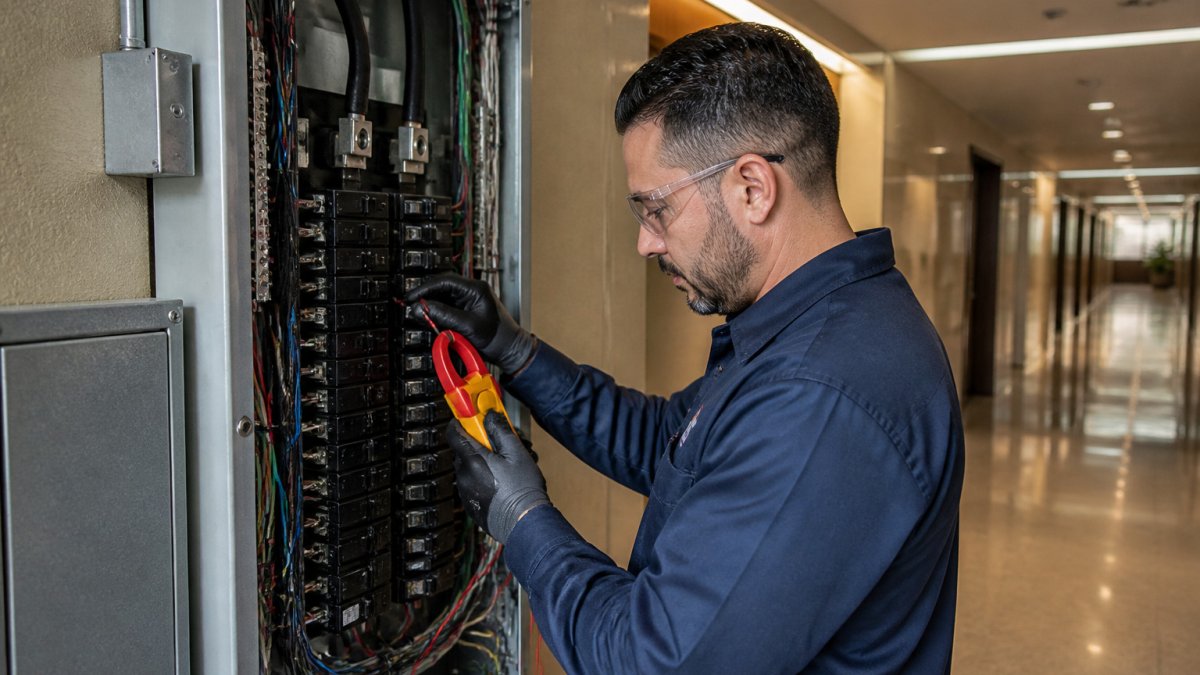
1. Confirm and document the symptom. The electrician asks what changed, when the problem started, and whether it affects one circuit, one area, or the whole service.
2. Isolate the affected circuit. Before any testing, the circuit is de-energized and locked out where possible. The electrician confirms the correct breaker, labels it, and checks that the circuit is actually dead with a tester, never by assumption.
3. Test for voltage, continuity, and load. A multimeter or clamp meter confirms whether voltage is present where it should be, whether a conductor is open, and whether a circuit is drawing more current than its rating. This is where overloaded circuits and loose neutrals usually reveal themselves.
4. Inspect connections and components. The electrician looks for heat damage, discolored insulation, scorch marks, and loose terminations at panels, junctions, and devices.
5. Confirm the cause before repairing. A repair made without a confirmed cause is a guess. The electrician identifies whether the fault is a failed component, a wiring defect, an overload, or a downstream equipment problem, then scopes the smallest safe repair that addresses the cause.
6. Repair, re-energize, and verify.
Stop and call a licensed electrician if you see sparking, smell burning, find scorched panel components, or have a breaker that trips again immediately after reset. Do not reset a breaker repeatedly, do not open a panel cover, and do not attempt to bypass a protective device. Those are signs of a fault that can escalate to fire or shock.
Where permits and code compliance enter. Repairs that alter wiring, add circuits, or replace service equipment generally require a permit and an inspection. Ask your electrician whether your repair needs a permit before work begins.
Why the sequence controls cost. A clear diagnosis keeps the repair focused. Skipping straight to replacing parts often means paying twice: once for the part that was not the problem, and again for the actual repair.
What Drives Commercial Electrical Repair Cost
Commercial electrical repair quotes are generally built from several inputs, including labor hours, parts and materials, access, permitting and inspection, and the scope of what must be restored. Understanding how each one moves the number helps you compare bids instead of guessing.
Labor hours. A licensed electrician’s time is the largest line item on most repair invoices. A simple failed receptacle or light fixture may take under an hour; tracing an intermittent fault across a multi-tenant panel can take several. Travel time and parking or loading access in dense commercial corridors also factor in.
Parts and materials. A standard breaker, receptacle, or ballast is inexpensive. Obsolete panels, specialty disconnects, and custom-length feeder cables can cost considerably more. If a part must be ordered, the job may also face a scheduling delay.
Access and after-hours work. Repairs in occupied retail, restaurant, or medical space often must happen before opening, after closing, or on a weekend, and those windows can cost more because they disrupt normal scheduling.
Permits and inspections. Work that alters wiring, adds circuits, or replaces a panel typically requires a permit and an inspection before the circuit is energized. The permit fee and the inspection wait are real costs and real schedule items, not paperwork formalities.
Scope. The cheapest repair that restores power is not always the right one. If a panel is already at capacity, replacing a tripped breaker without addressing the load just moves the failure downstream. A good estimate separates the immediate fix from the recommended follow-on work so you can decide.
Ask for a written estimate that breaks out labor, materials, permit fees, and any recommended follow-on work. A single lump-sum number makes it hard to compare bids or plan a budget.
Because these inputs vary so widely by building and fault, an on-site assessment is generally the most reliable way to scope a repair.
The main inputs behind a commercial electrical repair quote are summarised below.
| Cost driver | What it affects | Note |
|---|---|---|
| Labor hours | Largest line item on most invoices | Simple fixes take under an hour; tracing faults takes longer |
| Parts and materials | Breakers, receptacles, panels, cables | Obsolete or specialty parts cost more and may delay scheduling |
| Access and after-hours work | Occupied retail, restaurant or medical space | Before-opening, after-closing or weekend windows can cost more |
| Permits and inspections | Wiring changes, new circuits, panel replacement | Permit fees and inspection waits are real costs |
| Scope | Immediate fix versus follow-on work | Cheapest fix is not always the right one |
When You Need an Emergency Commercial Electrician
Call an emergency electrician when a problem creates a safety risk or stops operations. Our emergency electrical repair services guide explains what to do right away when power fails or a hazard appears. Sparking, burning smells, a total loss of power to part of a building, or a fault in a medical or food-service area should not wait for the next available appointment. Quick action limits damage and protects people on site.
Preventive Commercial Electrical Maintenance and Inspections
Routine maintenance can catch small problems before they become outages. Scheduled inspections of panels, connections, and high-load circuits can help identify heat, wear, and overloading early.
Consider this practical checklist for your next walkthrough:
- Check panels for warmth, scorch marks, or loose covers
- Test GFCI and AFCI devices on a set schedule
- Note any breakers that trip more than once
- Log lighting failures by location and date
- Confirm exit and emergency lighting still works
Booking Your Commercial Repair Estimate With Fox Electric
If you are dealing with a commercial electrical problem in Los Angeles, the fastest next step is an assessment. Fox Electric Technologies provides certified electricians for residential and commercial work, including panel upgrades, repairs, and new installations. Reach out through our request an electric repair estimate in Los Angeles page, or use our contact page to discuss your project with the team.
Frequently Asked Questions
What does commercial electrical repair include?
Commercial electrical repair covers diagnosing and fixing faults in building wiring, panels, breakers, outlets, lighting circuits and related equipment. Work typically starts with troubleshooting to find the root cause, followed by repairs that restore safe operation. Many jobs also include code-compliant replacement of damaged components and a final test to confirm the system works. Fox Electric Technologies handles both residential and commercial repair, and provides a free estimate so you know the scope before work begins.
How much does commercial electrical repair cost?
Commercial electrical repair cost depends on the type of fault, how hard it is to access the problem, the materials needed, and whether the work must happen outside business hours. Pricing is not set in advance for every job, so the most reliable step is to request a site assessment. Current pricing details are available on the Fox Electric Technologies website.
Can a business stay open during electrical repairs?
In many cases, yes. Electricians can often isolate the affected circuit and work in phases so that unaffected areas keep running. Work that requires shutting off power to a whole floor or panel is usually scheduled around peak hours or after close. Clear communication before the job starts helps reduce disruption. Ask your electrician for a phased plan so you know which areas will be affected and for how long.
Commercial electrical problems rarely fix themselves, and waiting usually raises the bill. Fox Electric Technologies offers certified electricians, code-compliant work, and clear communication from the first call. Request your estimate today and get your systems back to reliable operation.

