
Last Updated: October 28, 2026
Quick Summary
Yes, a 200 amp panel is usually enough for EV charging, but whether it works depends on your home’s existing load, not the panel size alone. A 200 amp service gives roughly 48,000 watts of capacity at 240 volts, while a typical Level 2 charger pulls 32 to 48 amps. A load calculation confirms if your panel can take the added load.
- A 40 amp charger counts as 50 amps against capacity because continuous loads count at 125%.
- A 48 amp charger adds 60 amps of continuous load and needs a 60A circuit breaker.
- NEC Article 625.42 lets a charger be sized to a listed load management system’s output instead of service capacity.
- Service-level energy management lets a 200 amp home charge at full speed without an upgrade.
- Panel upgrades add permanent headroom, while load management adds control but no added capacity.
Table of Contents
- The Short Answer: When a 200 Amp Panel Works for EV Charging
- How to Run an EV Charger Electrical Load Calculation
- Level 2 EV Charger Amperage: 30A, 48A, and What Your Panel Can Take
- Signs Your 200 Amp Panel Is Already Near Its Limit
- EV Charger Load Management: Charging Without a Service Upgrade
- Two EV Chargers on One 200 Amp Panel: What It Takes
- Panel Upgrade vs. Load Management: A Cost and Timeline Comparison
- Get a Straight Answer on Your Panel Before You Buy a Charger
- Frequently Asked Questions
The Short Answer: When a 200 Amp Panel Works for EV Charging
Yes, a 200 amp panel is usually enough for EV charging. But “usually” is doing a lot of work in that sentence. Whether a 200 amp panel is enough for EV charging depends on your home’s existing load, not the panel size alone.
A 200 amp service gives you roughly 48,000 watts of capacity at 240 volts. A typical Level 2 charger pulls 32 to 48 amps. That sounds like plenty of headroom, and for many homes it is. But your panel also feeds the oven, dryer, AC, and water heater. Add all those together and the math gets tighter than most homeowners expect.
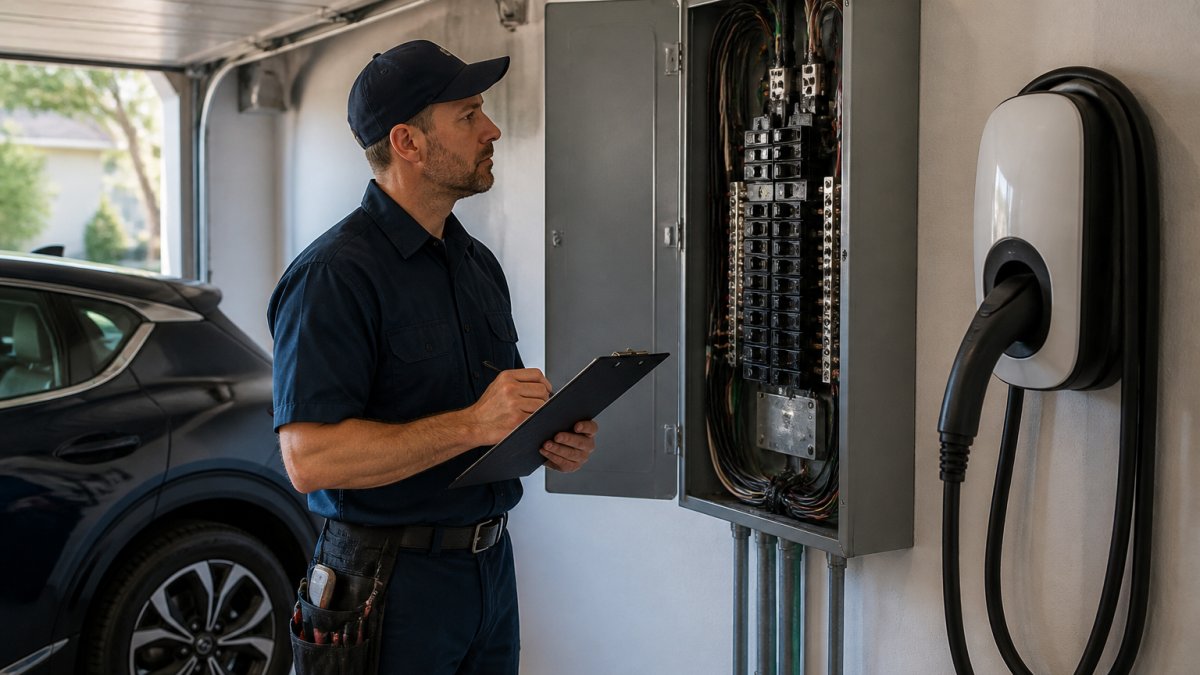
A load calculation can help assess whether a 200 amp panel near its limit can take a new 48 amp load.
If you already know your panel is smaller, you may be wondering whether a 100 amp panel can support an EV charger before assuming you need a full upgrade.
How to Run an EV Charger Electrical Load Calculation
An EV charger electrical load calculation adds up every load in your home, then compares the total to your panel’s capacity. The National Electrical Code (NEC) sets the method. Article 220 of the NEC load calculation requirements governs how you tally general lighting, small appliances, and major appliances, and Article 625 governs EV supply equipment specifically.
The core idea: continuous loads count at 125%. An EV charger running for hours is a continuous load, so a 40 amp charger counts as 50 amps against your capacity.
Standard Method vs. Optional Method
Load calculations can use different methods, and the method selected can change the result.
- Standard method (Part III): Tally general lighting and receptacles, apply demand factors, then add major appliances at nameplate rating. Conservative, and the default for most residential work.
- Optional method (Part IV): A simplified approach for dwellings with a single service. It uses a different demand-factor schedule and often yields a lower calculated load, which can be the difference between passing and needing an upgrade.
Step-by-Step Load Calculation Worksheet
This worksheet is an estimate, not a permit-ready calculation. Your AHJ may require the standard method, the optional method, or a specific form. A licensed electrician signs off on the real number.
If step 7 leaves you with less than the charger’s derated load, you have two paths: reduce the charger amperage, add load management, or upgrade the service. The next sections cover each.
Level 2 EV Charger Amperage: 30A, 48A, and What Your Panel Can Take
Level 2 EV charger amperage comes in tiers. A 30 amp charger adds about 24 amps of continuous load. A 48 amp charger adds 60 amps.
| Charger Amperage | Circuit Breaker | Continuous Load (125%) | Typical Miles per Hour |
|---|---|---|---|
| 30A | 40A | 30A | ~22 |
| 40A | 50A | 50A | ~30 |
| 48A | 60A | 60A | ~36 |
Signs Your 200 Amp Panel Is Already Near Its Limit
Any of these signals means you need a professional look before adding load. For a deeper look at what trips mean, read our guide on why circuit breakers trip.
EV Charger Load Management: Charging Without a Service Upgrade
The code backs this up. NEC Article 625.42 permits an EV charger to be sized to the load management system’s output rather than the service capacity, provided the system is listed and the installation is approved. That provision is why a 48 amp charger can legally sit on a 200 amp panel that would fail a straight load calculation.
The Three Hardware Categories
- Service-level energy management: A sensor clamps onto the service mains and a controller sheds or throttles the EV charger when total household demand approaches a set threshold. This is the category that lets a 100 amp or 200 amp home charge at full speed without an upgrade. It is the highest-value option for older homes.
- Charger-level power sharing: Two or more chargers on one circuit split available amps. Common in two-EV households. No service sensor needed, but it does not protect the rest of the panel from overload.
- Circuit-level load shedding: A device on the charger’s dedicated circuit interrupts or reduces charging when a priority load (dryer, range, AC) runs. Simpler and cheaper, but coarser than service-level control.
How Service-Level Load Management Works in Practice
The result: a 48 amp charger on a 200 amp panel that would otherwise fail the load calculation. The charger still delivers full power most of the night, because household demand is lowest exactly when you charge.
What to Check Before Relying on It
For a deeper look at what trips mean and when they signal a real capacity problem, read our guide on why circuit breakers trip.
Two EV Chargers on One 200 Amp Panel: What It Takes
Two EV chargers on one 200 amp panel may be possible, but whether they can operate at full power simultaneously depends on the home’s electrical load.
Panel Upgrade vs. Load Management: A Cost and Timeline Comparison
| Factor | Panel Upgrade | Load Management |
|---|---|---|
| Timeline | Longer, permit and utility coordination | Usually faster to install |
| Disruption | Power shutoff during swap | Minimal, no service interruption |
| Capacity Gained | Permanent added headroom | No added capacity, just control |
| Best For | Panels with no headroom, older gear | Panels with some headroom, modern gear |
| Permits | Required | Required in most areas |
Get a Straight Answer on Your Panel Before You Buy a Charger
At Fox Electric Technologies, our certified professionals provide safe, code-compliant electrical work, including panel upgrades and repairs.
Get a free estimate from Fox Electric Technologies. You can also book professional EV charger installation with licensed experts.
Frequently Asked Questions
Can a 200 amp panel handle a Level 2 EV charger?
Whether a 200 amp panel can handle a Level 2 EV charger depends on the home’s electrical load.
Can a 200 amp panel support two EV chargers?
Whether two EV chargers can operate on one 200 amp panel depends on the home’s electrical load.
Can load management let me install an EV charger without upgrading my panel?
Often, yes. A smart load management device monitors total household demand and reduces charger output when other high-draw appliances run, such as an electric range, dryer, or HVAC system. This can let you add Level 2 charging on a panel that would otherwise fail a load calculation, avoiding a service upgrade. The device must be listed and installed to code by a licensed electrician.
How do I know if my 200 amp panel has enough capacity for an EV charger?
Start with a load calculation. Add the square footage general load, then the nameplate ratings of fixed appliances, then the charger at 125 percent of its continuous rating. If the total stays under your service rating, you likely have room. Signs of trouble include a full breaker panel with no open slots, warm breakers, or a home with electric heat, a hot tub, and an electric range. An electrician can confirm in about an hour.

