
Last Updated: November 21, 2026
Quick Summary
Why do my lights dim when the refrigerator turns on? The fridge compressor pulls a brief surge of current when it starts, and that surge drops the voltage on the circuit feeding your lights. Dimming at startup is a common electrical question, and most of the time it is harmless.
- The compressor’s inrush current lasts less than a second, causing a momentary voltage sag.
- A normal dip is a blink, affects one or two fixtures, and happens once per compressor cycle.
- A shared branch circuit is the most common cause we find; a dedicated circuit for the fridge fixes it.
- LED drivers are sensitive to voltage dips, so LEDs flicker while incandescent bulbs hide the dip.
- Call an electrician when dimming is whole-house, persistent, or paired with heat, buzzing, or a burning smell.
Table of Contents
- Why Do My Lights Dim When the Refrigerator Turns On?
- When Lights Flicker When the Refrigerator Turns On: Normal Dip or Real Problem?
- Lights Dim When Appliances Turn On: The Load and Circuit Behind It
- Why LED Lights Flicker When the Fridge Comes On
- How to Fix Flickering Lights When an Appliance Starts
- When to Call a Professional Electrician
- Book a Free Electrical Inspection with Fox Electric Technologies
- Frequently Asked Questions
Why Do My Lights Dim When the Refrigerator Turns On?
Why do my lights dim when the refrigerator turns on?
A dimming light is your home telling you something about its wiring. Sometimes it is just a normal startup dip. Sometimes it points to a loose connection or a circuit that is maxed out.
Below, we explain what happens at startup, how to tell a normal dip from a real problem, and what to do next.
What Happens Inside the Fridge at Startup
The compressor is the heart of your refrigerator.
That burst lasts less than a second. But during that moment, the circuit voltage sags.
Think of it like a garden hose. When the fridge opens its valve wide, less pressure reaches the sprinkler at the end.
A healthy fridge does this every time the compressor cycles on. It is normal, and it is not a sign of danger on its own.
When Lights Flicker When the Refrigerator Turns On: Normal Dip or Real Problem?
A brief dip is normal. Persistent flickering is not.
A normal compressor startup dip generally lasts a fraction of a second, happens only at the instant the compressor kicks on, and leaves no other trace.
Use this symptom-based decision guide to sort what you are seeing. It is not a diagnosis, but it tells you whether to relax, watch, or call.
Duration
- Normal: a blink or a brief sag, then steady light while the compressor runs.
- Watch closely: dimming that lasts several seconds after startup, or a visible pulse each time the compressor cycles.
- Call: flicker or dimming that continues the entire time the compressor runs, or that never fully recovers.
Severity
- Normal: a slight change in brightness you notice only because you were looking.
- Watch closely: a pronounced drop that makes the room noticeably darker.
- Call: lights that nearly go out, or that surge brighter before settling.
Frequency
- Normal: once per compressor cycle, matching the fridge’s normal on-off rhythm.
- Watch closely: dimming that seems to happen more often than the fridge should cycle.
- Call: flickering that occurs randomly, including when the fridge is idle.
Scope
- Normal: one or two fixtures near the refrigerator.
- Watch closely: every light on the same circuit, including rooms adjacent to the kitchen.
- Call: lights dimming in rooms on other circuits, or across the whole home.
Accompanying signs
- Normal: none, just the momentary dip.
- Watch closely: a faint buzz at a switch or outlet that appears only during the dip.
- Call: buzzing, crackling, warmth at an outlet or switch plate, a burning smell, a breaker that trips, or lights that flicker even when the fridge is off.
A normal dip is a momentary voltage drop.
Use this symptom-based guide to sort a normal startup dip from a problem worth calling about.
| Symptom | Normal | Watch closely | Call |
|---|---|---|---|
| Duration | A blink or brief sag, then steady light | Dimming lasting several seconds after startup | Flicker the entire time compressor runs |
| Severity | Slight change you notice only if looking | Pronounced drop making room noticeably darker | Lights nearly go out or surge brighter |
| Frequency | Once per compressor cycle | More often than the fridge should cycle | Random flicker, including when fridge is idle |
| Scope | One or two fixtures near the refrigerator | Every light on the same circuit | Lights dimming on other circuits or whole home |
| Accompanying signs | None, just the momentary dip | Faint buzz at a switch or outlet during the dip | Buzzing, crackling, warmth, burning smell, tripped breaker |
Lights Dim When Appliances Turn On: The Load and Circuit Behind It
Lights dim when appliances turn on because every appliance adds load to a shared circuit. The more load, the bigger the voltage drop. The bigger the drop, the more your lights react.
Three things drive how bad the dip gets:
- The size of the appliance load. A fridge compressor is a heavy inductive load. A dishwasher or space heater can be even heavier.
- The circuit’s capacity. A branch circuit has a set limit. When it runs near that limit, small surges push it over.
- The wire and connections. Thin wire and loose connections add resistance, which makes the drop worse.
If your panel is old or undersized, the whole home feels it. An electrical panel upgrade gives modern appliances the capacity they need.
Shared Circuits, Undersized Wiring, and Loose Connections
The most common cause we find is a shared circuit. The fridge and the kitchen lights sit on the same branch circuit, so they fight for the same power.
Undersized wiring is the next culprit. Older homes often have wire too thin for today’s appliances. Thin wire heats up and drops more voltage.
Loose connections are the quiet danger. A loose neutral or a poor connection at an outlet adds resistance and heat. That is a fire risk, not just an annoyance.
Aluminum wiring from the 1960s and 1970s is a known problem (CPSC Urges Observance Of National Fire Prevention Week). If your home has old or failing wiring, a rewire in Los Angeles may be the right call.
Why LED Lights Flicker When the Fridge Comes On
LED lights can flicker when the fridge comes on because LED drivers are sensitive to voltage dips.
Incandescent bulbs hide the dip. Their filament stays hot for a moment, so the light barely changes. LEDs switch instantly, so the dip shows.
This is why LED lights flicker when fridge comes on even when the problem is minor. The bulb is not broken.
If only one LED fixture flickers, test a different bulb in that socket first.
How to Fix Flickering Lights When an Appliance Starts
You can narrow down the cause safely with a few checks. Do not open the panel, remove an outlet cover, or touch wiring. Stop at the first red flag and call a licensed electrician.
Here is the practical sequence we walk homeowners through. Run the checks in order.
- Note when it happens. Only at fridge startup? Write down the time, which lights dim, and whether the dip is a blink or lasts longer. A short log over a day or two is more useful than a single observation.
- Check the scope. Do lights dim in one room or the whole house? One room points to that branch circuit. Whole-house points to the panel, the service, or a shared neutral.
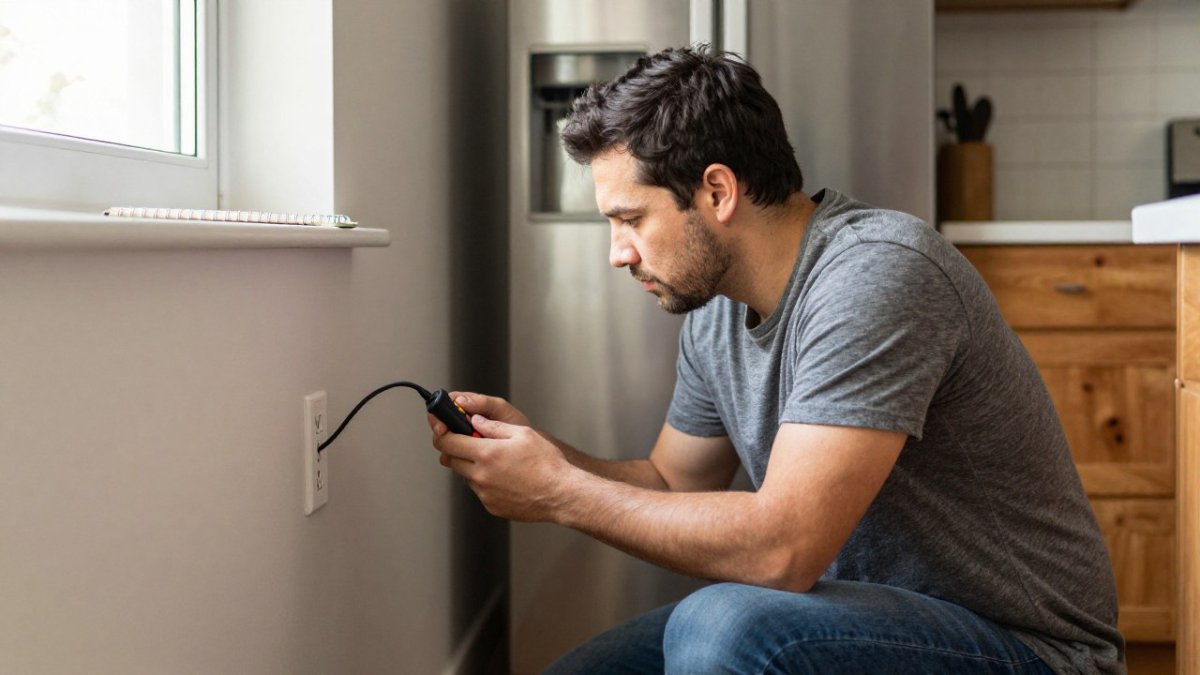
- Test at the outlet with a voltage tester. Plug the tester into an outlet on the same circuit as the flickering lights and watch it during a fridge startup. A healthy reading sits near 120 volts. A brief dip during startup is expected; a dip that stays low after the compressor settles, or a reading that wanders when nothing is running, is worth noting for an electrician.
- Try a different outlet for the fridge. If the fridge is on a circuit shared with kitchen lighting, moving it to a dedicated circuit, if one exists, and retesting tells you whether the shared load is the trigger.
- Check the fridge itself. A failing start relay or starting capacitor can make the compressor draw harder than it should. An appliance technician can test these; this is not a homeowner repair.
- Look and listen for warning signs. Warm outlet plates, buzzing, crackling, or a burning smell mean stop and call an electrician.
Watch out: a voltage tester gives you a snapshot, not a diagnosis.
A Safe, Step-by-Step Diagnostic Sequence
Run the checks in order, and stop at the first red flag. A whole-home dim points to the service or panel. A single-circuit dim points to that branch.
A simple symptom map helps separate the likely causes:
- One circuit, only at fridge startup: shared branch circuit or an undersized circuit for the load.
- One circuit, flicker even when the fridge is idle: a connection problem on that circuit.
- Whole home, only at startup: service capacity, panel condition, or a shared neutral.
- Whole home, random timing: loose neutral or service-side issue, call an electrician.
- Fridge-specific, with buzzing or heat at the fridge: appliance fault plus a circuit that should be checked.
For a deeper look at overloaded circuits, see our guide on why circuit breakers trip.
If the checks point to a shared circuit, the long-term fix is usually a dedicated circuit for the refrigerator.
When to Call a Professional Electrician
Call a licensed electrician when the dimming is whole-house, persistent, or paired with heat, buzzing, or a burning smell.
Also call if your home has aluminum wiring, an old fuse box, or a panel that trips often. These need an expert eye, not a DIY patch.
The National Fire Protection Association reports that home electrical failures cause tens of thousands of fires each year. Most start at connections and wiring you cannot see.
For a local repair, you can contact a licensed electrician in Los Angeles.
Book a Free Electrical Inspection with Fox Electric Technologies
A flickering light is a small clue. A full inspection turns it into a clear answer.
We focus on safe, code-compliant work. We handle residential and commercial electrical projects across the area, including panel upgrades and home rewiring.
Do not wait for a small dip to become a bigger problem. Contact us to schedule your free electrical inspection and get a straight answer on what your home needs.
A dimming light is easy to ignore until it is not. The right next step is a professional inspection that finds the cause before it becomes a hazard.
Frequently Asked Questions
Is it normal for lights to dim briefly when a refrigerator compressor starts?
Yes, a short dip is usually normal. A refrigerator compressor is an inductive motor that pulls a burst of starting current, often several times its running draw, for a fraction of a second. That surge briefly lowers voltage on the branch circuit, so nearby lights dim and then recover. If the dimming lasts less than a second, happens only at compressor startup, and the lights return to full brightness, your system is behaving as expected. Persistent flickering, buzzing, or dimming that lasts longer points to a wiring or circuit issue worth inspecting.
Why do LED lights flicker when the fridge comes on but incandescent bulbs do not?
LED bulbs run on a driver that converts household AC power to low-voltage DC. That driver is sensitive to small voltage drops, so when the compressor’s inrush current pulls the circuit voltage down, the driver can lose regulation and the LED flickers or drops out for an instant. Incandescent filaments just glow slightly dimmer because they respond to heat, not electronics. A dimmer-compatible LED, a quality driver, or moving the fridge to a dedicated circuit often reduces the flicker.
Can a refrigerator overload a circuit and cause lights to dim?
A refrigerator on its own rarely overloads a properly sized 20-amp kitchen circuit, but it can push a shared circuit close to its limit when other loads are running. If the fridge shares a branch circuit with kitchen lighting, a microwave, or a dishwasher, the combined draw during compressor startup can cause a noticeable voltage drop. An overloaded or undersized circuit, loose connections at the outlet or panel, and aluminum wiring are the usual culprits behind dimming that goes beyond a brief dip.
When should I worry about lights flickering when the refrigerator turns on?
Call an electrician if the flickering lasts more than a second, happens every time the compressor cycles, affects lights across multiple rooms, or comes with buzzing, burning smells, or warm outlet covers. Persistent flickering, lights that stay dim, or breakers that trip alongside the dimming point to loose connections, an overloaded circuit, or a service problem. A licensed electrician can measure voltage at the panel and outlets, check connections, and confirm whether the circuit needs upgrading.

