
Table of Contents
- Trout Electric vs Volta Electric: At a Glance
- Trout Electric: Scope, Warranty, and Where It Shines
- Volta Electric: What Its Service Model Means for You
- Residential Electrical Service Cost Estimates: What Drives the Number
- Questions to Ask an Electrician Before Hiring
- How to Vet Electrical Contractors: A Step-by-Step Checklist
- Warranty and Workmanship: The Fine Print That Matters
- Conclusion
- Frequently Asked Questions
Last Updated: September 25, 2026
Trout Electric vs Volta Electric: At a Glance
Choosing between Trout Electric and Volta Electric comes down to scope, not price alone. This comparison from Fox Electric Technologies breaks down how each contractor handles Trout Electric vs Volta Electric projects, from EV charger installation to panel upgrades. Trout Electric is an electrical contracting service built around residential and commercial installations, with full-service EV charger setups, permit handling, and a one-year workmanship warranty. Volta Electric operates on a service model centered on scheduled project work and quoted jobs.
The practical difference shows up in three places: who pulls the permits, what the warranty actually covers, and how each company handles load calculations for modern energy demands.
| Factor | Trout Electric | Volta Electric |
|---|---|---|
| Service focus | Residential and commercial installs | Project-based electrical service |
| EV charger work | Full-service, including wall connectors | Quoted per project |
| Permit handling | Included in service scope | Confirm before signing |
| Workmanship warranty | 1-year stated coverage | Ask for written terms |
| Service area | Limited to specific regions | Varies by project |
| Best for | EV infrastructure and panel work | Standard electrical projects |
Trout Electric: Scope, Warranty, and Where It Shines
Trout Electric’s public positioning is built around EV infrastructure, and that focus shapes everything else about how a project runs. The company handles full-service charger installation, including Tesla wall connectors and other hardwired Level 2 EVSE, and it manages the permit as part of the job rather than handing that step to the homeowner.
What the one-year workmanship warranty actually covers
A stated one-year workmanship warranty is a labor warranty, not a hardware warranty. The distinction matters:
- Workmanship warranty, covers the installation itself. If a charger trips a breaker three months in because a lug was torqued wrong or a conductor was undersized, that is a workmanship failure, and it falls under the contractor’s warranty.
- Manufacturer warranty, covers the hardware. If the EVSE unit itself fails, the manufacturer replaces the unit, but labor to remove and reinstall it is usually excluded.
Where the model falls short
Two limitations show up consistently with this kind of EV-focused contractor:
- Geographic coverage is limited. The service area is restricted to specific regions. If you sit outside those regions, the permit handling and the warranty never come into play, you are comparing a quote from a company that will not service you.
- No published pricing. Trout Electric quotes per project. You will not find a rate card, which means you cannot benchmark the number before you call. The practical workaround is to ask for a line-item estimate that separates labor, materials, and permit fees so you can compare scope against another bid.
The load calculation question
For load management and shared-parking installations, Trout Electric’s EV experience is a real advantage, but only if the load calculation is documented. A 100-amp service panel feeding an EV charger plus a house full of appliances needs a proper load calculation under the National Electrical Code, not a guess. A 48-amp hardwired charger alone draws roughly 11.5 kW at 240 volts, which is a meaningful fraction of a 100-amp service.
National Electrical Code overview from NFPA
Volta Electric: What Its Service Model Means for You
Volta Electric runs on a project-based quote model. You describe the work, the company scopes it, and you receive a fixed number before work starts. That structure is common among electrical contractors, and it has real consequences, some good, some you need to manage.
What the fixed-quote model gets you
A fixed quote transfers cost risk to the contractor. If the job takes longer than expected, you still pay the quoted figure. That suits straightforward work:
- Circuit breaker replacement
- A new outlet run or dedicated circuit
- Lighting installation or fixture replacement
- A straightforward panel swap where the service amperage is not changing
Where the model shifts risk back to you
The trade-off is transparency. With no published pricing and no stated warranty terms in its public materials, you carry more of the verification burden than you would with a contractor that publishes both. Three things need to be confirmed in writing before you sign:
- Who pulls the permit. This is the single most important line in the contract. If the homeowner pulls it, you own the inspection risk, and a failed inspection means paying twice for the same work.
- What the workmanship warranty covers and for how long. A fixed quote with no stated warranty is not the same product as a fixed quote with a one-year labor warranty. Get the terms in writing, including what voids coverage.
- Whether a load calculation is included for any EV charger or large-appliance addition. A fixed quote that skips the load calculation is not actually fixed, it is a number that may change once the inspector looks at the panel.
How the quote model affects project speed
Project-based quoting introduces a step between your first call and the start of work: the site visit and scope. For a simple job, that step is fast. For EV charger installation or a panel upgrade, it can add days or weeks depending on scheduling and whether the contractor needs to verify the existing service first. If your timeline is tight, for example, you are coordinating with a vehicle delivery date, ask upfront how far out the company is booking and whether the quote can be turned around in a set number of days.
Never sign an electrical contract that does not state who pulls the permit. If the homeowner pulls it, you own the inspection risk, and failed inspections mean paying twice for the same work.
The head-to-head takeaway
Set side by side, the two models answer different questions. Trout Electric bundles permit handling and a stated one-year workmanship warranty into an EV-focused service, which reduces your administrative burden but limits you to its service area. Volta Electric’s project-based quote gives you a fixed figure on predictable work but leaves permit handling, warranty terms, and load calculations as items you must confirm yourself.
Residential Electrical Service Cost Estimates: What Drives the Number
Residential electrical service cost estimates vary because the work varies. Four factors move the number more than anything else.
- Panel capacity. Moving from 100-amp to 200-amp service means new hardware, new breakers, and often a utility disconnect.
- Permit and inspection fees. These are set by the local authority, not the contractor.
- Wire runs. Distance from the panel to the work area drives labor hours.
- Code corrections. Older homes with outdated wiring often need fixes before new work can pass inspection.
Questions to Ask an Electrician Before Hiring
The right questions to ask an electrician before hiring separate a qualified contractor from a risky one. Five questions do most of the work.
- Are you licensed, and what is your license number?
- Who pulls the permit for this job?
- What does your workmanship warranty cover, and for how long?
- Will you provide a written load calculation?
- Can you give me three recent references for similar work?
Ask for the license number, then verify it against your state’s contractor board database before you sign. It takes five minutes and eliminates the single biggest hiring risk.
How to Vet Electrical Contractors: A Step-by-Step Checklist
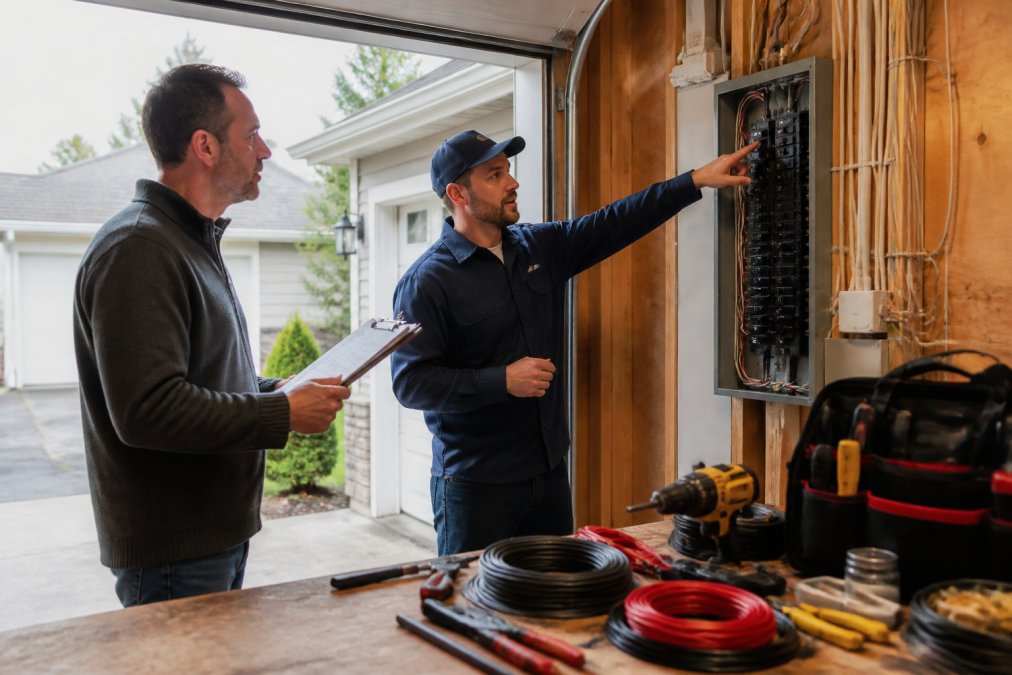
How to vet electrical contractors comes down to verification, not conversation. Work through this checklist before you sign anything.
- Confirm the license number against your state database
- Verify general liability and workers’ compensation coverage
- Ask who pulls the permit and who pays for reinspection
- Request a written load calculation for any panel or EV work
- Get the workmanship warranty terms in writing
- Call two references from jobs completed in the last year
- Confirm the estimate is line-itemed, not a lump sum
- Check that the contract names the exact hardware being installed
Warranty and Workmanship: The Fine Print That Matters
Warranty terms are where electrical contracts hide their real differences. A one-year workmanship warranty means the contractor returns if the install fails. A manufacturer warranty only covers the hardware, and it usually excludes labor.
Conclusion
Comparing electrical contractors is really a test of documentation: licenses, permits, load calculations, and warranty terms. Trout Electric bundles permit handling and a stated one-year workmanship warranty into its EV-focused service. Volta Electric quotes per project and leaves more verification to you.
Frequently Asked Questions
Are Trout Electric and Volta Electric licensed and insured?
Both companies present themselves as professional electrical contractors, but licensing status should always be verified directly. In California, check the Contractors State License Board (CSLB) database for an active C-10 electrical license, and ask each company for a certificate of insurance showing general liability and workers’ compensation coverage. A legitimate contractor will provide these without hesitation. If a company cannot produce a license number or proof of insurance on request, treat that as a serious red flag before signing anything.
What should I look for when comparing electrical contractors?
Focus on four things: license verification through the CSLB, proof of insurance, a written scope of work with itemized costs, and a workmanship warranty. Trout Electric advertises a 1-year warranty on workmanship and includes permit handling in its service scope. Ask every contractor whether permits are pulled in their name, who handles inspection scheduling, and what happens if the work fails inspection. A contractor who answers these clearly is usually the safer hire.
How do I request a quote from an electrical contractor?
Start by describing the job in writing: panel upgrade, EV charger installation, rewiring, or repair. Include your panel’s amperage, the age of your home, and any photos of the existing setup. Ask for a written estimate that separates labor, materials, and permit fees. For residential electrical service cost estimates, expect the contractor to either visit or request photos before quoting. Fox Electric Technologies offers a free estimate, which lets you compare scope and pricing before committing to a full inspection.
What are the benefits of hiring a professional electrical company over a handyman?
Electrical work touches load calculations, circuit breaker sizing, voltage requirements, and local electrical code. A handyman typically cannot pull permits, which means the work may fail inspection and create insurance problems later. Licensed electricians carry liability coverage and can issue documentation that satisfies city inspectors. For anything beyond swapping a light fixture, such as a panel upgrade or EVSE installation, hire a licensed contractor. The cost difference is small compared to the risk of non-compliant work.
