
Last Updated: November 8, 2026
Quick Summary
The panel upgrade vs subpanel choice depends on whether you need more total power or just more breaker spaces. A subpanel adds circuits in a new location but never raises your home’s available amps, while a main panel upgrade increases total service capacity. A load calculation decides which one your home actually needs.
- A subpanel is fed from the main panel by a feeder breaker and adds breaker spaces closer to where circuits are needed.
- A panel upgrade usually requires utility coordination and a power outage of most of a day, while a subpanel tie-in causes only a brief outage.
- Published estimates put a standard panel replacement at roughly $1,000-$5,000, while a full service upgrade commonly runs $5,000-$30,000.
- You can often add a subpanel when the main panel is full of breakers, but only if the service itself has spare capacity.
- Skipping the load calculation and sizing a subpanel from open breaker slots alone is the most common way homeowners end up with a subpanel that solves nothing.
Table of Contents
- Panel Upgrade vs Subpanel: The Core Difference in One Minute
- Electrical Panel Upgrade vs Subpanel Installation Pros and Cons
- Electrical Panel Upgrade vs Subpanel Installation Cost: What Drives Each Number
- Can You Add a Subpanel If the Main Panel Is Full?
- Capacity vs Breaker Spaces: The Load Calculation That Decides It
- 100 Amp Subpanel: When It Is Enough and When It Is Not
- Permits, Inspection, and Planning for Future Electrical Load
- Get a Free Estimate Before You Choose an Upgrade or Subpanel
- Frequently Asked Questions
Panel Upgrade vs Subpanel: The Core Difference in One Minute
The panel upgrade vs subpanel decision comes down to one question: does your home need more total power, or just more places to plug things in? A subpanel adds breaker spaces in a new location.
The answer is rarely obvious from looking at your panel. According to Lawrence Berkeley National Laboratory’s study on residential panel upgrade costs and barriers, timelines and costs for these projects vary widely with the scope of work involved.
What a Main Panel Does and Why It Sets the Ceiling
The main panel is where utility power enters your home. Its main breaker caps how many total amps your service can draw at once. A 100-amp service can’t feed a new EV charger, a heat pump, and a kitchen remodel at once, no matter how many slots sit open.
What a Subpanel Adds (and What It Cannot Add)
A subpanel is a secondary distribution board fed from the main panel by a feeder breaker. It adds breaker spaces closer to where circuits are needed, which is why detached garages and workshops use them. As Epic Electrical’s comparison of panel upgrades and subpanel installations explains, a subpanel adds circuits or distribution in another location, while a main-panel or service upgrade addresses overall capacity.
Electrical Panel Upgrade vs Subpanel Installation Pros and Cons
The electrical panel upgrade vs subpanel installation pros and cons split cleanly along capacity. A panel upgrade solves an undersized service and future loads. A subpanel solves distance and circuit count. Here is how each option actually performs:
| Factor | Main Panel Upgrade | Subpanel Installation |
|---|---|---|
| What it increases | Total service capacity and breaker spaces | Breaker spaces in a new location only |
| Best for | Undersized service, EV chargers, full remodels | Detached garages, workshops, additions |
| Utility coordination | Usually required | Not usually required |
| Power outage during work | Yes, most of a day | Brief, for the feeder tie-in |
| Future electrification | Strong position | Limited by existing service |
Main panel upgrade pros: resolves overloaded panels, supports major appliances and EV charging, and brings grounding and bonding up to current code. Cons: higher cost, a utility disconnect, and a full-day outage.
Subpanel pros: cheaper, faster, and ideal for a detached garage or workshop needing its own circuits. Cons: it inherits the main panel’s limits, if the service is maxed out, a subpanel just moves the bottleneck.
Electrical Panel Upgrade vs Subpanel Installation Cost: What Drives Each Number
Cost is where the two options separate most, and the gap is not just a single number. Published estimates put a standard panel replacement at roughly $1,000-$5,000, while a full service upgrade with new service entrance equipment commonly runs $5,000-$30,000, according to Caudill’s 2026 electrical panel upgrade cost guide. A 200-amp panel and service upgrade that includes a new meter, grounding, and surge protection is estimated at about $4,300-$8,700 for 2026, per ProjectCostPro’s electrical panel cost calculator.
-
Service equipment and enclosure: the panelboard, main breaker, meter base, and weatherhead or mast. A 200-amp panelboard and main breaker is a material line item on its own; a meter base and new mast add to it when the service entrance is rebuilt.
-
Feeder and service-entrance conductors: wire size scales with amperage and run length. A 200-amp service uses larger conductors than 100-amp, and a long meter-to-panel run adds cost quickly.
-
Grounding and bonding: ground rods, the grounding electrode conductor, water-pipe bonding, and equipment bonding jumpers, often upgraded because older homes may not meet current bonding requirements.
-
Subpanel enclosure and main lug or main breaker: a 100-amp subpanel is a modest material cost; a 200-amp subpanel with a main breaker costs more.
-
Feeder breaker and feeder conductors: the breaker in the main panel and the wire run to the subpanel. Feeder length and gauge are the biggest variables, especially for a detached garage or a shop at the back of the property.
-
Grounding and bonding at the subpanel: equipment grounding conductor sizing and separation of neutral and ground bars, a code-sensitive detail.
To compare quotes, ask each contractor to separate equipment, labor, permit fees, utility charges, and any allowance for correcting existing wiring. Our breakdowns of the cost of a 200 amp panel upgrade and the cost of upgrading a 100 amp electrical panel walk through these numbers line by line.
Watch out: a quote that does not list the utility disconnect, meter base, and grounding scope separately can hide costs that appear later as change orders.
Estimated costs for panel and service upgrades
Can You Add a Subpanel If the Main Panel Is Full?
Yes, you can often add a subpanel if the main panel is full of breakers, but only if the service itself has spare capacity. “Full” usually means no open breaker slots, not that the service is maxed out. An electrician runs a load calculation to confirm the existing service can carry the added feeder load. If it can, the subpanel gets its own feeder breaker, and circuits move to the new box.
Capacity vs Breaker Spaces: The Load Calculation That Decides It
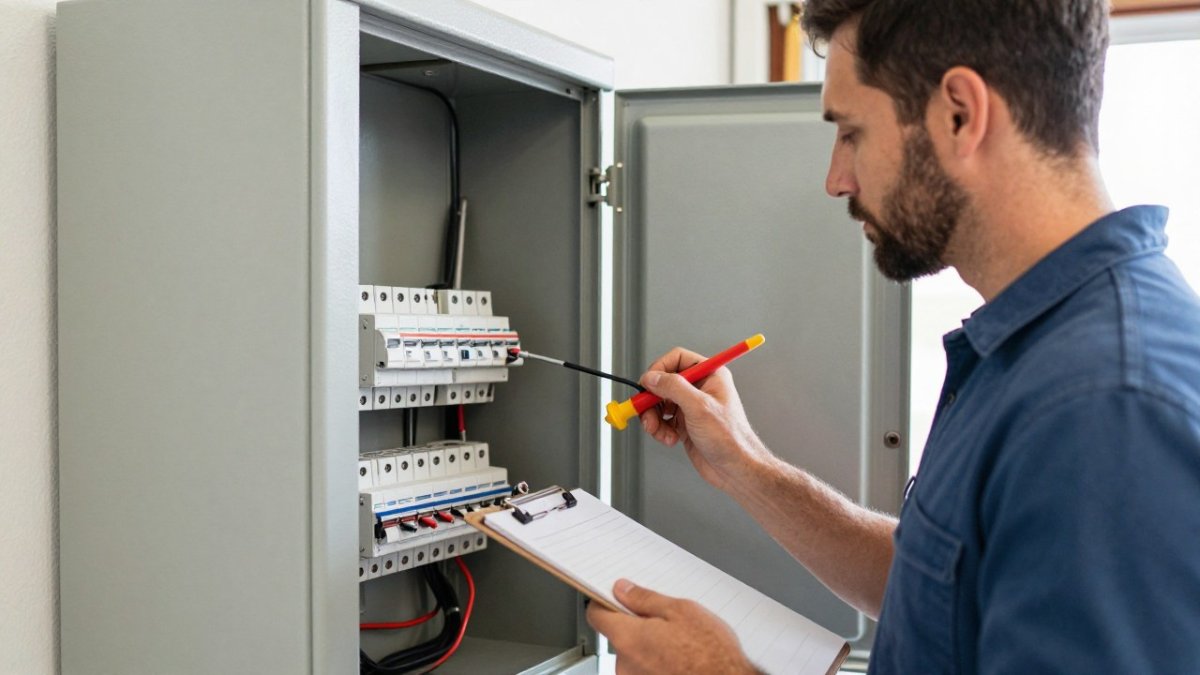
A load calculation is the formal estimate of how much electricity your service must supply, based on square footage, major appliances, and fixed equipment.
How the calculation is assembled
Most residential calculations follow a standard method that starts with general lighting and receptacle load based on square footage, then adds specific loads for fixed appliances and equipment:
- General load: a baseline allowance per square foot for lighting and general-use receptacles.
- Small-appliance and laundry circuits: fixed allowances for kitchen small-appliance branch circuits and the laundry circuit.
- Fixed appliances: water heater, range, cooktop, wall ovens, dishwasher, disposal, and similar equipment at nameplate rating with the allowed demand factors.
- HVAC: the larger of the heating or cooling load, since they typically do not run together at full draw.
- Planned loads: EV charging, a heat pump, induction cooking, a hot tub, or new circuits for a remodel.
- Compare to service rating: the calculated demand is compared to the service amperage, with the continuous-load and headroom rules that apply.
Turning the result into a decision
The output is not a single yes-or-no answer. It points to one of three paths:
- Demand fits with headroom and slots are open: add the circuits directly. No subpanel and no upgrade needed.
- Demand fits with headroom but slots are full or the new circuits are far from the panel: a subpanel is a reasonable fix. It adds breaker spaces and shortens circuit runs without changing service capacity.
- Demand exceeds the service rating, or the planned load is large and continuous: a main panel or service upgrade is the honest answer. A subpanel would only move the bottleneck.
A common pattern: a home with 100-amp service, a gas range and gas water heater, and a plan to add an EV charger.
Why the calculation matters more than the panel label
The amperage printed on the main breaker is the ceiling, but the calculation tells you how close you are to it.
100 Amp Subpanel: When It Is Enough and When It Is Not
A 100 amp subpanel is enough when the loads it serves are modest and the main service has capacity to spare. A detached garage with lighting, outlets, and a small compressor fits comfortably. A workshop running a welder, a dust collector, and a heater at once may not.
Best for: detached garages, workshops, and additions that need their own circuits. Skip if: the main service is already near its limit, or you plan to add an EV charger on that service. If you’re weighing a 100-amp service against EV charging, our guide on whether a 100 amp panel can support an EV charger tests that exact scenario.
Permits, Inspection, and Planning for Future Electrical Load
Both options require a permit and inspection in most jurisdictions, and a panel upgrade usually adds utility coordination for the disconnect and reconnect. The process follows a predictable path:
- Pull the permit before any work begins
- Schedule the utility disconnect for a service upgrade
- Complete the installation and grounding updates
Plan for future load while the panel is open. Electrification is pushing this issue: the American Council for an Energy-Efficient Economy’s research on the electrical panel barrier assembled what it describes as the first national dataset on residential panel characteristics, reflecting how often existing panels limit new electric loads. If an EV charger or heat pump is on your five-year plan, size the upgrade for it now rather than paying twice.
Get a Free Estimate Before You Choose an Upgrade or Subpanel
The right answer depends on your service amperage, your calculated load, and what you plan to add, not something to guess from breaker slots alone.
Start with our panel installations and upgrades service page to see how we scope the work, or go straight to electrical panel upgrade in Los Angeles to request your project.
Your panel is the ceiling on everything you want to add, from an EV charger to a remodeled kitchen. Get that ceiling right once, and every future project gets easier.
Frequently Asked Questions
Should I add a subpanel or upgrade the main panel?
It depends on where the limit sits. If your service has enough capacity and you only need more breaker spaces or circuits in a distant area like a garage or workshop, a subpanel is usually the smaller, cheaper job. If the service itself is undersized, a subpanel will not fix it, because adding breaker spaces does not increase the home’s total electrical capacity. A load calculation on the existing service is the deciding step.
Can you add a subpanel if the main panel is full?
Sometimes, but not always. A full panel with no open breaker slots can often accept a subpanel through a feeder breaker, provided the service capacity and busbar rating support the added load. If the panel is an outdated model with no room for a feeder and no spare capacity, the honest answer is that a main panel upgrade comes first. An electrician confirms this with a load calculation and a physical inspection of the panel and service entrance.
Does adding a subpanel increase the electrical capacity of a home?
No. A subpanel adds circuit locations and breaker spaces, not total service capacity. The home’s capacity is set by the service amperage coming in, typically 100 amps or 200 amps. If you are adding a major appliance, an EV charger, or a remodel, the load calculation tells you whether the existing service can carry it. When it cannot, a panel or service upgrade is the only path that actually raises capacity.
Can you run a 100 amp subpanel off a 100 amp service?
Not at full rating. A 100 amp subpanel fed from a 100 amp service would leave nothing for the rest of the house, and the feeder breaker alone would consume the entire service capacity. In practice, a subpanel on a 100 amp service is usually sized smaller, often 50 to 60 amps, and only after a load calculation confirms the main service has room. If the service is already near its limit, a 200 amp upgrade is the more realistic answer.
Should a 50-year-old electrical panel be replaced?
Age alone does not condemn a panel, but 50 years puts it in the range where parts, breaker availability, and safety design become concerns. Federal Pacific and Zinsco panels from that era are widely treated as replacement candidates by electricians. Look for scorch marks, a burning smell, breakers that trip without load, or a panel with no available replacement breakers. A licensed electrician can tell you whether repair or replacement is the safer call.

