
Table of Contents
- What Drives the Cost of Upgrading a 100 Amp Electrical Panel
- Signs You Need a New Electrical Panel
- Electrical Panel Replacement Permit Requirements
- How Long Does an Electrical Panel Upgrade Take?
- 100 Amp vs. 200 Amp Service: Which Do You Actually Need?
- Hidden Costs of Service Entrance Upgrades
- Frequently Asked Questions
Last Updated: September 18, 2026
What Drives the Cost of Upgrading a 100 Amp Electrical Panel
The cost of upgrading a 100 amp panel depends on three variables: the amperage you move to, whether the service entrance must be replaced, and local permit and inspection fees. A straight panel swap costs far less than a full service upgrade because the utility feed, meter socket, and mast stay untouched.
Labor vs. Material Costs
Labor typically accounts for the larger share of any panel project. A licensed electrician must de-energize the service, disconnect every circuit, mount the new enclosure, land the breakers, torque terminations to specification, and label the directory. That work takes a full day for a simple swap and longer when circuits must be traced or extended.
The most expensive mistake homeowners make is hiring on price alone. A cut-rate install that fails inspection means paying twice: once for the original work and again for corrections, plus reinspection fees.
Permits, Inspection, and Utility Fees
Permit fees, inspection charges, and utility disconnect or reconnect fees are fixed costs you cannot negotiate away. Many jurisdictions require a permit before any panel work begins, and the utility often needs advance notice to pull the meter.
Signs You Need a New Electrical Panel
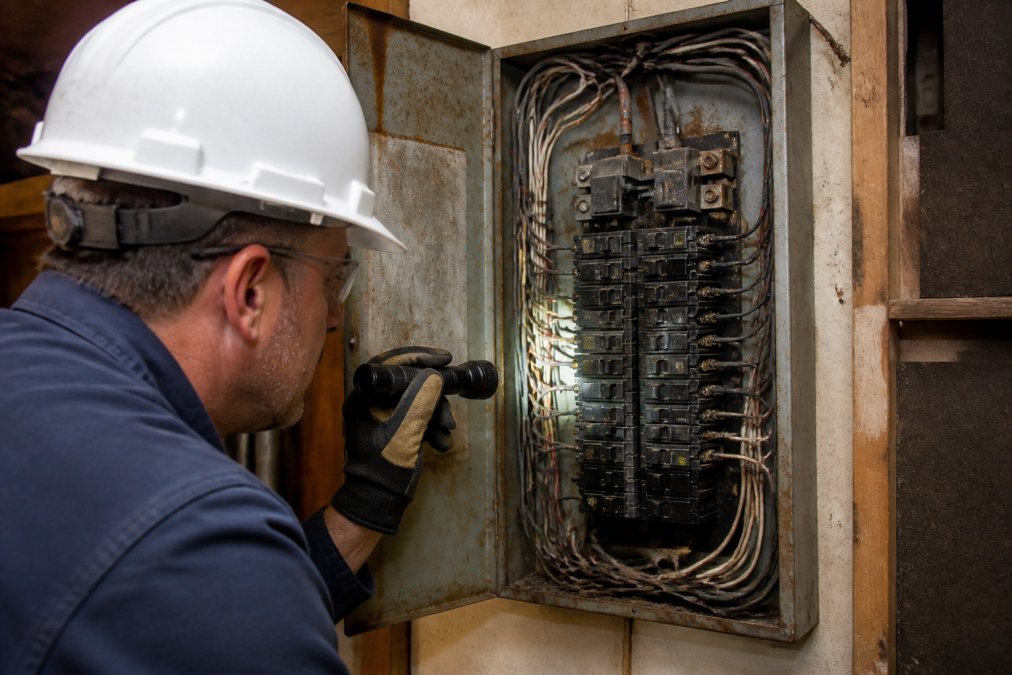
You need a new electrical panel when breakers trip repeatedly under normal load, the enclosure feels hot, you see rust or scorch marks, or your panel still uses fuses. Breakers that will not reset and burning smells are immediate safety signals.
Warning Signs Homeowners Miss
Double-tapped breakers, where two wires share one terminal, are a common defect that rarely announces itself. Warm cover plates and faint buzzing are easy to dismiss until they are not.
- Breakers that trip when the microwave and toaster run together
- A panel directory written in pencil, or missing entirely
- Flickering lights when large appliances start
- A service mast with cracked weatherhead insulation
- Aluminum branch wiring without approved connectors
Electrical Panel Replacement Permit Requirements
Electrical panel replacement permit requirements vary by jurisdiction, but nearly every U.S. building department requires a permit and a passed inspection before the utility restores power. The permit exists so a third party verifies the work before it carries load.
What the Inspection Process Actually Checks
An inspector verifies grounding and bonding, conductor sizing, breaker compatibility, torque values, working clearances, and the circuit directory. They will look at the service entrance conductors, the meter socket, and whether the panel is listed for the intended use.
How Long Does an Electrical Panel Upgrade Take?
A standard panel replacement takes one to two days of on-site work, while a full service upgrade with a new mast and meter socket often runs two to three days. Add waiting time for the permit and the utility disconnect, which can push the total project to one or two weeks.
Here is how the timeline typically breaks down:
| Phase | Typical Duration | What Happens |
|---|---|---|
| Permit application | 1-5 business days | Plans reviewed, permit issued |
| Utility disconnect | 1-10 business days | Meter pulled, service de-energized |
| On-site work | 1-3 days | Panel swapped, circuits landed, labeled |
| Inspection | 1-3 business days | Inspector verifies code compliance |
| Utility reconnect | 1-5 business days | Power restored, system energized |
100 Amp vs. 200 Amp Service: Which Do You Actually Need?
A 100 amp panel is sufficient for a small home with gas appliances and no high-draw additions. A 200 amp service is the practical choice for homes with electric ranges, electric water heaters, central air, EV chargers, or heat pumps. The decision comes down to a load calculation, not square footage alone.
What 100 Amps Actually Carries
A 100 amp service provides 24,000 watts at 240 volts. General lighting and receptacles for a typical home consume roughly 3 watts per square foot plus small-appliance and laundry circuits, which after demand factors usually lands between 6,000 and 9,000 watts. That leaves roughly 15,000 to 18,000 watts for everything else, and large appliances do not share politely.
| Load | Typical Draw | Notes |
|---|---|---|
| Electric range | 8,000-12,000 W | Nameplate; demand factor applies |
| Electric water heater | 4,500-5,500 W | Continuous load |
| Central A/C | 3,500-5,000 W | Largest motor, 125% factor |
| Heat pump (with backup) | 4,000-15,000 W | Backup strips dominate |
| Level 2 EV charger | 7,200-11,520 W | 30-48 A continuous |
| Electric dryer | 5,000-5,500 W | Often on its own circuit |
EV Chargers and Heat Pumps: When 100 Amps Runs Out
An EV charger alone can draw 40 to 50 amps continuously, which consumes most of a 100 amp service before the rest of the house is counted. Under the NEC, a continuous load is calculated at 125% of its rating, so a 40 amp charger counts as 50 amps against the service. Heat pumps add another significant continuous load, and if the system has electric resistance backup strips, those strips can pull 10 kW or more on a cold morning, which is exactly when the heat pump is also running.
The Break-Even Question
A 200 amp service does not cost twice what a 100 amp service costs. The panel enclosure and main breaker are a modest line item; the labor, permit, mast, meter socket, and service entrance conductors are largely the same whether the new service is 100 or 200 amps. That is why most electricians recommend going to 200 amps whenever the service entrance is already being replaced, the incremental material cost is small relative to the total project, and it avoids a second full upgrade later.
Ask your electrician to run the load calculation before you commit to a scope, and ask them to show you the numbers. Some homes need only a panel swap, while others need the full service entrance replaced. Knowing which one you are buying prevents quote shock later.
Hidden Costs of Service Entrance Upgrades
The hidden costs of a service entrance upgrade sit outside the panel itself: trenching, conduit, a new service mast, meter socket replacement, and repairing the wall after the old equipment comes out. These items appear once the wall is open, not in the original estimate. Most guides stop at that list. The more useful question is why each one gets triggered, because that is what determines whether your quote stays flat or climbs.
Why a Panel Swap Becomes a Service Upgrade
A panel swap replaces the enclosure and breakers but leaves the utility feed, meter socket, mast, and service entrance conductors in place. A service upgrade replaces all of it. The two are quoted differently, and the gap between them is the single largest source of quote variance in this category.
The trigger is usually one of four things:
- Undersized service entrance conductors. The wires from the utility connection to the panel are sized for the existing amperage. Moving to 200 amps requires larger conductors, which means new wire from the meter to the panel at minimum.
- An obsolete meter socket. Many older sockets are rated for 100 amps or are not listed for the new service size. The utility will not reconnect to a socket that does not match the service rating.
- A failing or undersized mast. Overhead service masts carry the drop from the utility and must be sized and braced for the new load. Cracked weatherhead insulation or a rusted mast means replacement, not reuse.
- Grounding electrode system deficiencies. A new service often requires an updated grounding electrode conductor and bonding to water and gas piping per NEC Article 250. If the existing grounding is inadequate, it is part of the scope.
Utility Fees and Disconnect/Reconnect Charges
Most utilities charge a fee to pull the meter for a service upgrade and another to reconnect and re-seal it. Some require the work to be scheduled through a specific process, and some will not reconnect until they have a copy of the passed inspection. These fees are set by the utility, not the contractor, and they are not negotiable.
Trenching and Underground Service
If your service is underground, a service upgrade may require trenching from the utility pedestal or transformer to the meter. Trenching costs depend on length, depth, soil, and whether the run crosses concrete, landscaping, or a driveway. Restoration, sod, pavers, concrete, is almost never included in the electrical quote and is often the largest single surprise.
Wall Repair and Finish Work
The gap between a panel swap and a full service upgrade is the single biggest source of quote variance. Ask any contractor to state explicitly which one their price covers, and ask them to itemize utility fees, trenching, mast and meter socket replacement, and wall repair as separate lines.
For a straight swap, most homeowners can expect a straightforward project. For a service entrance upgrade, budget for the unknowns behind the wall. A reputable contractor will walk the property and flag these before work begins rather than surprising you mid-project.
Frequently Asked Questions
How much does it cost to upgrade a 100 amp electrical panel to 200 amps?
The cost of upgrading a 100 amp panel to 200 amps depends on labor rates, permit fees, and whether the service entrance needs new conductors or a mast. A simple panel swap costs less than a full service upgrade that includes trenching or a new meter socket. Fox Electric Technologies provides transparent, itemized estimates so you know exactly what you are paying for before work begins. Request a free estimate for your specific home.
Do I need a permit to upgrade my electrical panel?
Yes. Electrical panel replacement permit requirements apply in nearly every jurisdiction. You need a permit before any work starts, and the installation must pass an inspection by your local building department. The permit fee is usually a few hundred dollars, but skipping it can void your homeowner’s insurance and create problems when you sell. A licensed electrician handles the paperwork and schedules the inspection for you.
How long does an electrical panel upgrade take?
Most residential panel upgrades take one to three days of on-site work. A straightforward 100 amp to 200 amp swap with no wiring problems can finish in a single day. If the electrician finds outdated wiring, needs a new service mast, or the utility has to disconnect and reconnect power, the timeline stretches. Permit approval and inspection scheduling can add one to three weeks before and after the work.
Is a 100 amp panel enough for a modern home?
A 100 amp panel can handle a small home with gas appliances and no EV charger. Add central air conditioning, an electric range, a heat pump, or a Level 2 EV charger and the load calculation often exceeds 100 amps. Most electricians recommend 200 amp service for homes over 2,000 square feet or any home adding high-draw appliances. A load calculation gives you a definitive answer.
What are the signs you need a new electrical panel?
Common signs you need a new electrical panel include breakers that trip repeatedly, fuses that blow, a burning smell near the panel, rust or corrosion inside the box, and flickering lights when appliances start. Panels with known safety issues, such as Federal Pacific Stab-Lok or Zinsco models, should be replaced regardless of age. If your panel uses fuses instead of circuit breakers, it cannot support modern electrical demands.
Upgrading a panel is one of those projects where the cheapest bid usually costs the most in the end. Fox Electric Technologies handles panel upgrades and home rewiring with certified electricians, code-compliant work, and honest pricing quoted upfront, whether you need a simple swap or a full service entrance replacement with EV charger capacity. Get your free estimate from Fox Electric Technologies and know exactly what your panel needs before the first breaker is pulled.
