
Table of Contents
- Why Medical Suites Need Specialized Electrical Maintenance
- NFPA 99 Healthcare Facility Requirements: What Facility Managers Must Know
- Medical Office Electrical Inspection Checklist
- Preventive Electrical Maintenance for Clinics: Protecting Critical Equipment
- HIPAA-Compliant Electrical Infrastructure and Data Security
- The Cost of Downtime: Why Preventive Maintenance Pays Off
- Frequently Asked Questions
Last Updated: September 30, 2026
Why Medical Suites Need Specialized Electrical Maintenance
Commercial electrical maintenance for medical suites is the practice of inspecting, testing, and servicing the power, grounding, and life-safety systems that keep clinical equipment running safely. It differs from standard commercial work because a single voltage sag can interrupt patient care.
At Fox Electric Technologies, we treat medical suites as critical-power environments, not offices with extra outlets. Diagnostic imaging, ventilators, and electronic health record servers all depend on clean, uninterrupted power. When that power fails, the consequences go well beyond a dark room.
The stakes are why this work sits in its own category. A retail store loses sales during an outage. A medical suite loses something harder to recover.
NFPA 99 Healthcare Facility Requirements: What Facility Managers Must Know
NFPA 99, the healthcare facilities code published by the National Fire Protection Association, defines how healthcare spaces must be wired, grounded, and protected. Facility managers should read it as a compliance floor, not a suggestion.
The code assigns risk categories to different spaces and sets requirements accordingly. A procedure room where patients receive care faces stricter rules than a waiting area. Understanding which category each space falls into is the first step in planning maintenance.
Essential Electrical System Types and Their Maintenance Implications
The essential electrical system is the portion of a facility’s wiring designed to keep critical loads powered when the normal supply drops. It typically includes life-safety branches, critical branches, and equipment branches, each with its own reliability expectations.
Maintenance implications follow directly from those branches. Life-safety systems, such as exit lighting and fire alarms, need the most frequent testing. Critical branches feeding patient-care equipment need documented transfer testing. Equipment branches, which may power imaging or lab gear, still require scheduled checks.
For the full text and current editions, consult the NFPA 99 healthcare facilities code. Local adoption of the code varies, so confirm which edition applies to your building before scheduling work.
Medical Office Electrical Inspection Checklist
A medical office electrical inspection checklist is a written schedule of tasks that keeps a facility audit-ready and equipment protected. The checklist should map every task to a frequency, a responsible party, and a documented pass/fail criterion. Most competitors stop at “inspect the panel.” A medical-specific checklist has to go further, because the standards that govern clinical space are more prescriptive than those for general commercial buildings.
The Standards Behind the Checklist
Three documents drive most of the task list:
- NFPA 99 (Health Care Facilities Code), assigns risk categories to spaces and sets testing requirements for the essential electrical system.
- NFPA 70 (National Electrical Code), Article 517, covers health care facilities wiring, including patient care areas, isolated ground receptacles, and redundant grounding.
- NFPA 110, governs emergency and standby power systems, including generator testing and transfer switch exercise.
Local adoption of each code varies, so confirm which edition your authority having jurisdiction enforces before you build the schedule. The NFPA 99 healthcare facilities code page lists current editions and amendments.
Monthly, Quarterly, and Annual Inspection Tasks
- Monthly: Exercise the generator for at least 30 minutes under available load and log the result; test 90-minute battery-backed emergency egress lighting; verify that transfer switches are in the correct normal position; scan for any logged voltage anomalies on branch circuits feeding patient care areas.
- Quarterly: Perform infrared thermal imaging on panels, switchgear, and busways while under load; verify grounding and bonding connections at patient care area receptacles; confirm that isolated ground receptacles in procedure rooms read correctly; review circuit breaker maintenance records and exercise any breaker not operated in the prior quarter.
- Annually: Run a full power quality analysis (harmonics, transients, voltage sags, and swells); complete a load balancing review across all three phases; torque switchgear terminations to manufacturer specification; perform generator maintenance per NFPA 110 including fuel, coolant, battery, and transfer switch testing; verify that all line isolation monitors in procedure rooms alarm correctly when faulted.
Documentation That Survives an Audit
A checklist is only as good as its paper trail. Every task should produce a record that names the technician, the date, the instrument used, the reading taken, and the pass/fail result. Thermal images should be stored with the corresponding load reading, because an image without a load value tells you almost nothing. Generator logs should capture start time, transfer time, run duration, and any fault codes. When a surveyor or insurer asks, the log is the answer.
Build the checklist in a spreadsheet first, then move it into your CMMS. The spreadsheet forces you to name every task and frequency before software hides the gaps behind a template.
This schedule is a starting point, not a universal standard. Facilities with imaging equipment, operating suites, or on-site laboratories typically need tighter intervals and additional tasks. A preventive maintenance agreement with a licensed master electrician lets you adjust intervals to the actual risk in each space and keeps the documentation current.
Preventive Electrical Maintenance for Clinics: Protecting Critical Equipment
Preventive electrical maintenance for clinics protects the diagnostic equipment that patients and staff depend on. A scheduled program catches failing breakers, loose connections, and degrading insulation before they take a system down.
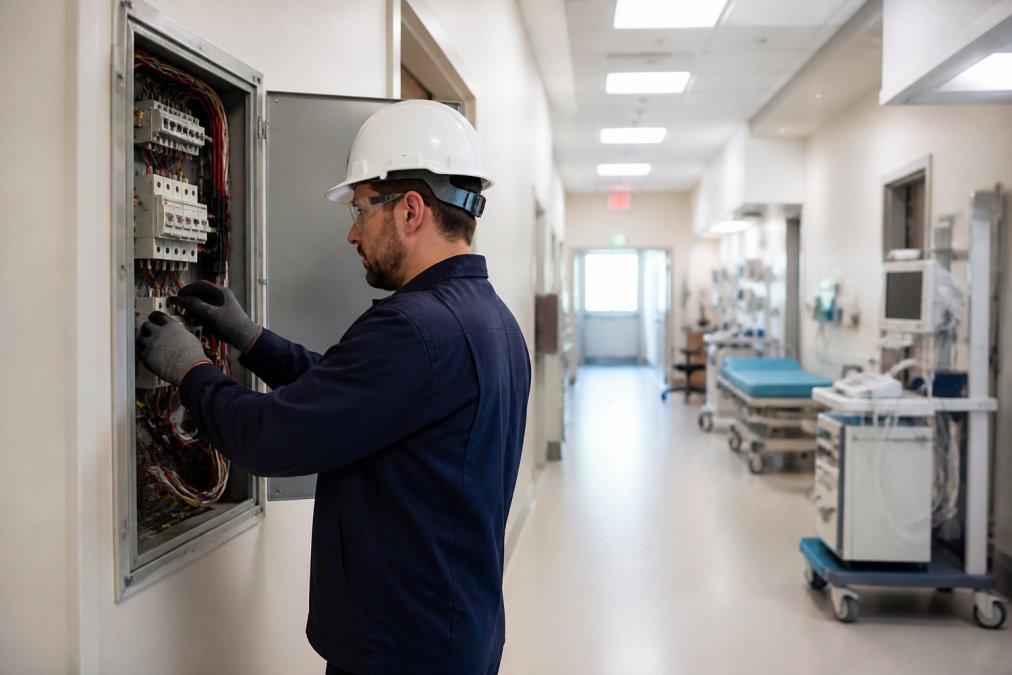
Ask your electrician to photograph every panel before and after service. The photo log becomes your evidence trail for inspections and insurance, and it takes minutes to build.
HIPAA-Compliant Electrical Infrastructure and Data Security
HIPAA-compliant electrical infrastructure is the set of power and grounding practices that keep protected health information systems available and secure. The HIPAA Security Rule requires covered entities to protect the confidentiality, integrity, and availability of electronic health records.
The Cost of Downtime: Why Preventive Maintenance Pays Off
Downtime in a medical suite costs more than the repair bill. Cancelled appointments, delayed imaging, and diverted patients all carry a price that rarely shows up in the maintenance budget. The gap in most competitive articles is that they stop at that sentence. A facility manager needs a framework, not a slogan.
The Four Cost Buckets of an Outage
When you build the business case for preventive maintenance, separate the loss into four buckets:
- Direct revenue loss, appointments that cannot be rescheduled, procedures that must be referred out, and imaging slots that go unfilled. This is the easiest bucket to estimate because it maps to your scheduling system.
- Perishable and irreplaceable loss, refrigerated vaccines, blood products, reagents, and any specimen that depends on continuous temperature control. A single overnight outage can wipe out a season’s worth of inventory.
- Recovery cost, equipment recalibration, EHR system integrity checks, re-sterilization of instruments, and staff overtime to rebuild the schedule. These costs land days after the lights come back on.
- Reputation and referral loss, patients and referring physicians who experience a cancellation often do not return. This bucket is the hardest to quantify and the most expensive over a multi-year horizon.
A Simple Way to Run the Numbers
You do not need a consultant to build a defensible estimate. Start with three inputs:
- Average revenue per clinical hour, total monthly collections divided by clinical hours open.
- Expected outage duration, use your utility’s historical reliability data plus the last three unplanned events at your site.
- Probability of an unplanned event per year, most facilities can pull this from their own work order history.
Where Prevention Actually Moves the Needle
The tasks that most reliably prevent outages are not glamorous. Thermal imaging finds loose lugs before they arc. Torque testing catches terminations that have loosened since installation. Generator load bank testing proves the system will carry the load it is rated for, not just that it starts. Grounding verification prevents the intermittent faults that are the hardest outages to diagnose.
Skipping generator load testing because it is disruptive is a common shortcut. The consequence shows up the first time the utility feed drops and the transfer switch does not engage. At that point, the fix costs far more than the test would have, and the outage is measured in patient care, not dollars alone.
The Trade-Off to Be Honest About
Preventive maintenance is not free, and it is not always convenient. Thermal scans require the panels to be under load, which means scheduling around clinical hours. Generator load bank tests are loud and disruptive. Torque testing on switchgear may require a planned shutdown. The right question is not whether these tasks are disruptive, but whether the disruption of a planned test is smaller than the disruption of an unplanned outage.
Frequently Asked Questions
What are the NFPA 99 standards for healthcare electrical systems?
NFPA 99 establishes risk-based requirements for healthcare facilities, classifying essential electrical systems into Type 1, Type 2, and Type 3 based on patient risk. Type 1 applies to critical care areas like operating rooms and ICU, requiring the highest reliability. The standard covers grounding, wiring, and backup power, and mandates regular testing of critical components to ensure operational continuity.
How often should medical suites undergo electrical inspections?
The frequency depends on your facility’s risk category and local codes. Most medical suites benefit from monthly visual checks, quarterly testing of emergency systems, and annual comprehensive inspections by a licensed electrician. High-risk areas like operating rooms may need more frequent testing. Following a preventive inspection schedule helps you stay compliant with NFPA 99 and avoid costly downtime.
What is the difference between general commercial and medical-grade electrical maintenance?
Medical-grade maintenance goes beyond standard commercial work. It includes testing isolated power systems, verifying redundant grounding, and ensuring backup generators start within 10 seconds. Technicians must also understand how electrical noise affects diagnostic equipment. Medical suites require documentation for regulatory audits, while general commercial maintenance focuses on safety and efficiency without the same compliance burden.
Who is responsible for electrical safety compliance in a medical office?
The facility manager or practice owner holds ultimate responsibility for electrical safety compliance. They must ensure that all work meets NFPA 99 and NEC standards, maintain inspection records, and schedule regular maintenance. Partnering with a licensed electrician who specializes in healthcare environments helps you meet these obligations and pass inspections on the first try.
A single unplanned outage can erase months of careful facility planning. Fox Electric Technologies provides certified electricians, safe code-compliant work, and honest pricing for medical suites and commercial spaces that cannot afford to go dark. Our team handles panel upgrades, preventive maintenance agreements, and emergency repairs with the precision these environments demand. Get started with Fox Electric Technologies and keep your critical systems running without interruption.
