
Table of Contents
- Signs You Need Home Rewiring
- Why Do Circuit Breakers Trip and What It Means
- Age of Your Home and Wiring Integrity
- How Long Does Home Wiring Last and When Replacement Is Necessary
- Cost to Rewire a House: What to Expect
- DIY Assessment vs. Professional Inspection
- Getting a Professional Evaluation
- Frequently Asked Questions
Last Updated: October 2, 2026
Signs You Need Home Rewiring
Your electrical system is the backbone of your home. When it starts failing, the dangers escalate quickly. Signs you need home rewiring range from obvious warning signals to subtle problems that only a trained eye catches. At Fox Electric Technologies, we help homeowners identify these red flags before they become safety hazards or fire risks.
The most common indicators fall into distinct categories. Some are immediate and visible. Others develop gradually over months or years. All of them deserve professional attention.
Frequent Circuit Breaker Trips
Your circuit breaker exists to protect you. When it trips repeatedly, it’s telling you something is wrong.
A breaker that flips once every few months might be normal. A breaker that trips multiple times per week signals an underlying problem. This happens when circuits carry too much load or when there’s a short circuit somewhere in the wiring.
Common causes include:
- Too many devices running on one circuit
- Faulty appliances drawing excess power
- Damaged or degraded wiring creating resistance
- Water damage affecting insulation
- Aluminum wiring corroding at connection points
If resetting the breaker temporarily solves the problem, you’re dealing with an overload. If it trips immediately after reset, there’s likely a short circuit. Either way, this demands professional diagnosis. Ignoring it risks electrical fire.
Frequent breaker trips are your home’s early warning system. Bypassing or replacing a breaker without fixing the underlying cause is dangerous and violates electrical code. Have a licensed electrician inspect the circuit.
Flickering or Dimming Lights
Lights that flicker or dim when other appliances run indicate voltage fluctuation. This happens when your electrical system can’t deliver stable power to all circuits simultaneously.
The problem might be localized to one room or affect your entire house. Whole-house dimming usually points to an undersized electrical panel or degraded main service lines. Single-room issues often stem from overloaded circuits or loose connections.
Watch for these patterns:
- Lights dim when the air conditioner kicks on
- Lights flicker when the dryer or oven runs
- Lights dim gradually throughout the day
- One room consistently experiences dimming while others don’t
Flickering lights aren’t just annoying. They stress your appliances and reduce their lifespan. They also indicate that your electrical system is struggling to meet your home’s power demands. Modern homes with multiple high-draw devices often need panel upgrades or rewiring to maintain stable voltage.
Burning Smells or Visible Smoke
This is an emergency. Stop using the affected circuit immediately and call a licensed electrician.
Burning smells near outlets, switches, or the electrical panel mean insulation is overheating and degrading. Smoke indicates active burning. Both are fire hazards that require immediate professional assessment.
The source could be:
- Overheated wiring due to excessive current
- Damaged insulation exposing live conductors
- Arcing inside walls or conduit
- Failed connections generating heat through resistance
Never ignore these signs. Don’t attempt to locate the source yourself. Turn off power to the affected area at the breaker panel if you can do so safely, then call for emergency service.
Burning smells or smoke from electrical components indicate imminent fire risk. Do not delay. Contact a licensed electrician immediately or call emergency services if the smell is strong or smoke is visible.
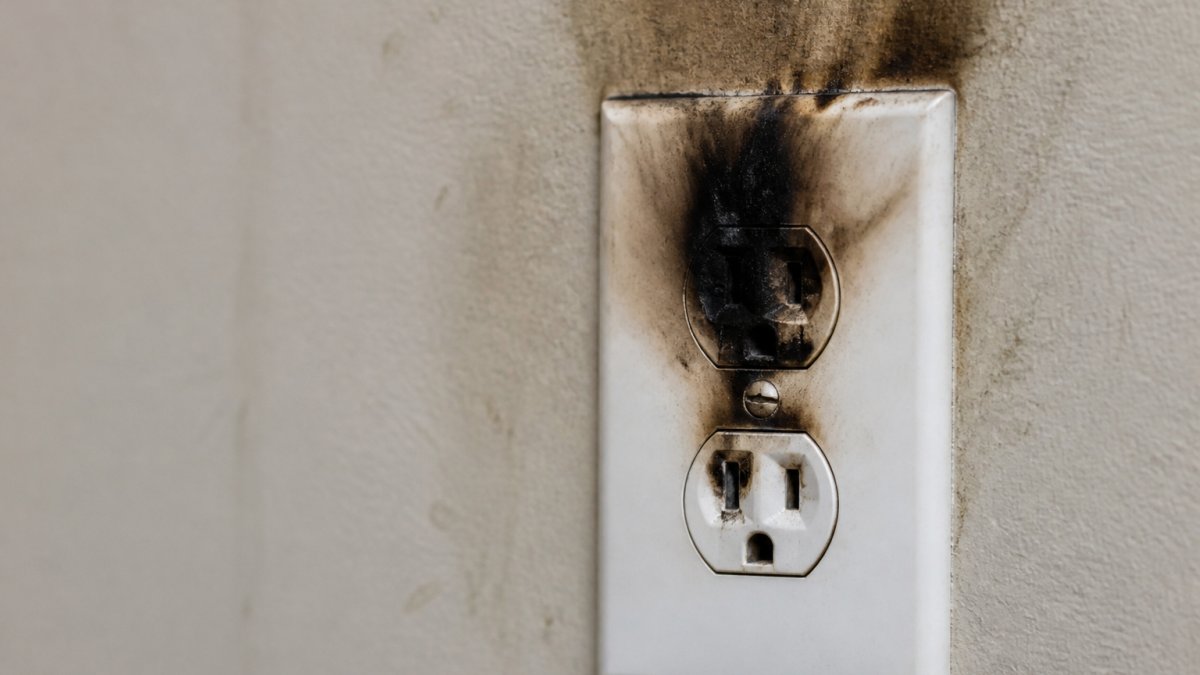
Discolored or Scorched Outlets
Outlets that are blackened, brown, or scorched have experienced heat damage. This means current has been arcing or flowing through resistance at that location.
Discoloration around outlet faceplates often indicates:
- Loose connections inside the outlet
- Wiring that’s too small for the load
- Damaged insulation allowing current to escape
- Corrosion at terminal connections
Even if the outlet still works, the damage is done. The wiring behind the wall may be compromised. Replace the outlet immediately and have the circuit inspected. If multiple outlets show discoloration, you likely need rewiring in that area.
Why Do Circuit Breakers Trip and What It Means
Understanding why breakers trip helps you recognize serious problems. Your circuit breaker is a safety device designed to interrupt current flow when demand exceeds safe limits.
A circuit breaker trips when current exceeds the amperage rating of that circuit. This could mean you’re drawing too much power at once, or there’s a short circuit forcing excess current through the wire.
Most homes have 15-amp or 20-amp circuits for standard outlets. A 20-amp circuit can safely handle about 2,400 watts of continuous load.
- Overloaded circuits: Your home’s electrical panel lacks sufficient capacity for modern appliance use
- Short circuits: Damaged wiring creates an unintended path for current
- Ground faults: Current is leaking to ground through damaged insulation
- Faulty breakers: The breaker itself is failing and tripping prematurely
If a breaker trips when nothing is plugged in or running on that circuit, you have a ground fault or short circuit. This is not an overload problem and will not resolve by unplugging devices.
Age of Your Home and Wiring Integrity
Older homes often have wiring that’s decades past its intended lifespan. Electrical systems degrade over time through heat exposure, insulation breakdown, and corrosion.
Knob-and-Tube Wiring
Knob-and-tube wiring was common in homes built before 1950. It consists of individual wires run through ceramic knobs and tubes for support and insulation.
This wiring type has significant limitations:
- No ground wire for safety
- Insulation deteriorates rapidly
- Cannot handle modern electrical loads
- Creates fire hazards when insulation fails
- Not compatible with modern appliances
- Fails electrical code inspections
Aluminum Wiring and Outdated Panels
Homes built in the 1960s and 1970s sometimes have aluminum wiring instead of copper. Aluminum expands and contracts more than copper, causing connections to loosen over time.
Aluminum wiring problems include:
- Loose connections that generate heat
- Corrosion at terminal points
- Incompatibility with modern outlets and switches
- Higher resistance than copper, causing voltage drop
- Increased fire hazard at connection points
If your home was built before 1980, have a licensed electrician inspect your wiring type and panel capacity. Knob-and-tube wiring requires replacement. Aluminum wiring needs evaluation. Undersized panels may need upgrading.
How Long Does Home Wiring Last and When Replacement Is Necessary
Most residential wiring is designed to last 50-70 years under normal conditions. But several factors accelerate degradation.
Signs that wiring is failing include:
- Frequent breaker trips without obvious cause
- Burning smells from outlets or walls
- Flickering lights throughout the house
- Discolored outlets or switches
- Buzzing or crackling sounds from outlets
- Shocks from touching appliances or outlets
Cost to Rewire a House: What to Expect
Home rewiring is a significant investment. The scope and complexity vary widely based on your home’s size, current wiring condition, and local code requirements.
Several factors influence cost:
- Home size: Larger homes require more materials and labor
- Wiring type: Removing old knob-and-tube or aluminum wiring costs more than upgrading modern wiring
- Panel upgrade: Adding a new electrical panel increases total cost
- Accessibility: Finished walls require more work than open framing
- Local codes: Some jurisdictions require additional safety features
- Extent of work: Partial rewiring of specific circuits costs less than whole-house replacement
Homeowners with homes built before 1980, homes showing multiple warning signs, or homes needing panel upgrades should prioritize professional inspection and cost estimates. Early assessment prevents emergency situations and allows planning for the work.
DIY Assessment vs. Professional Inspection
You can identify some warning signs yourself. You should never attempt electrical repairs or comprehensive assessment without proper training.
What homeowners can observe:
- Burning smells or visible discoloration at outlets
- Frequent breaker trips
- Flickering lights
- Buzzing or crackling sounds
- Age of the home and visible wiring condition
What requires professional expertise:
- Testing insulation integrity with specialized equipment
- Measuring voltage drop and circuit capacity
- Identifying hidden wiring problems inside walls
- Assessing panel capacity and upgrade needs
- Determining code compliance
- Creating a safe rewiring plan
Getting a Professional Evaluation
Start by scheduling an inspection with a licensed electrician. Explain your concerns clearly. If you’ve noticed flickering lights, frequent breaker trips, or burning smells, mention them specifically.
During inspection, the electrician will:
- Test circuits for proper grounding
- Measure voltage and amperage
- Inspect outlets and switches for damage
- Evaluate the electrical panel
- Assess wiring condition where visible
- Identify code compliance issues
- Recommend repairs or upgrades
Frequently Asked Questions
How can I tell if my house needs to be rewired?
Watch for multiple warning signs: frequent circuit breaker trips, flickering or dimming lights, burning smells near outlets, discolored faceplates, buzzing sounds from the electrical panel, and two-prong outlets throughout the home. If your house is over 50 years old with original wiring, a professional inspection is critical. Homes with knob-and-tube or aluminum wiring should be evaluated immediately, as these pose serious electrical fire hazards.
Why do circuit breakers trip frequently in homes needing rewiring?
Circuit breakers trip when they detect an overloaded circuit or short circuit to protect your home from electrical fires. Frequent trips indicate your electrical system cannot handle your home’s current power demands, or there is a fault in the wiring itself. This is especially common in older homes where the electrical panel was sized for outdated appliances and devices. A licensed electrician can diagnose whether you have overloaded circuits, degraded insulation, or wiring integrity issues requiring rewiring.
How long does home wiring last before it needs replacement?
Most residential wiring is designed to last 50 years or longer if properly installed and maintained. However, factors like insulation degradation, environmental conditions, and electrical code compliance affect lifespan. Knob-and-tube wiring from pre-1950s homes and aluminum wiring from the 1960s-1970s often fail before 50 years. If your home is approaching or exceeding 50 years old, a safety inspection is essential to assess whether your wiring integrity has deteriorated.
What is a typical cost to rewire a house?
Rewiring costs depend on your home’s size, wiring type, electrical panel condition, and whether the work is partial or complete. Pricing varies based on local labor rates, accessibility, and code requirements. For an accurate estimate tailored to your specific situation, a licensed electrician must inspect your electrical system and assess the scope of work needed. Contact Fox Electric Technologies for a free estimate to understand your home’s requirements.
