
Table of Contents
- Understanding 100 Amp Service Capacity for EV Charging
- NEC Load Calculation for EV Chargers: Step-by-Step
- Level 2 Charger Power Requirements and Your Panel
- EV Energy Management Systems: A Smarter Alternative to Upgrades
- Cost of Upgrading 100 Amp Electrical Panel: What to Expect
- Safety Considerations for Older Panels and Professional Inspection
- Vehicle-to-Home (V2H) Future-Proofing Your Electrical System
- Frequently Asked Questions
Last Updated: September 20, 2026
Understanding 100 Amp Service Capacity for EV Charging
Can a 100 amp panel support an EV charger? Sometimes, it depends on your home’s existing electrical load. This guide from Fox Electric Technologies covers the math, the code rules, and the alternatives.
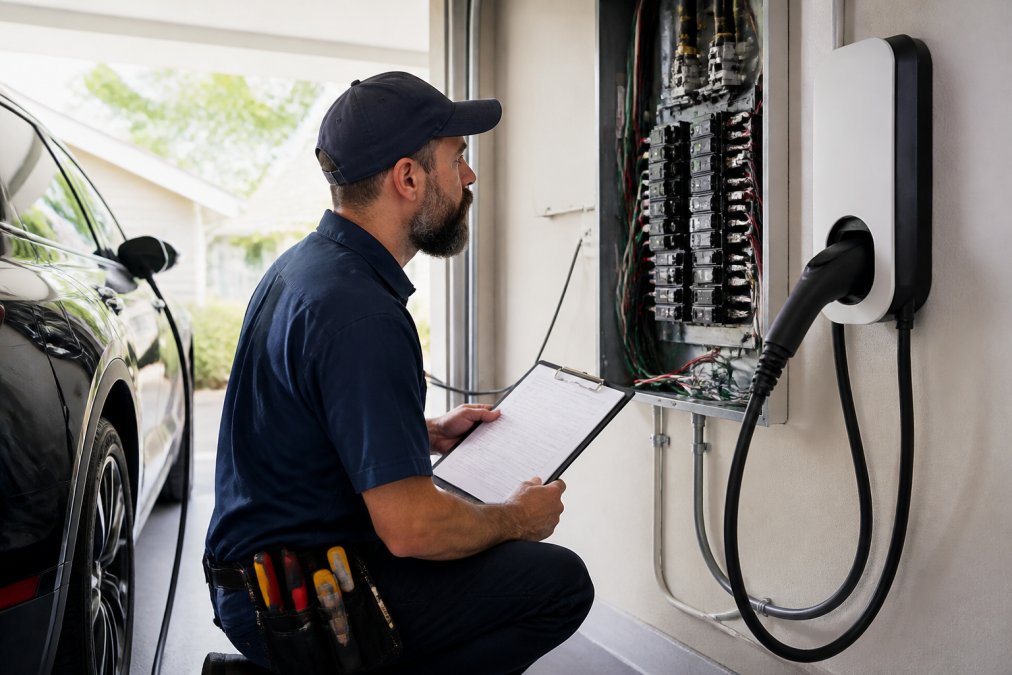
What a 100 Amp Panel Actually Delivers
A 100 amp panel delivers 24,000 watts at 240 volts, plenty until you add up real household demand.
Here is what a typical home draws:
- Central air conditioner: 15-20 amps
- Electric range: 30-40 amps
- Electric water heater: 18-20 amps
- Dryer: 20-25 amps
- Lights and outlets: 10-15 amps
How EV Chargers Draw Power
Level 1 chargers plug into a standard 120-volt outlet and draw about 12 amps, gentle on a 100 amp panel, but slow, at 3-5 miles of range per hour.
NEC Load Calculation for EV Chargers: Step-by-Step
The NEC load calculation is the only honest way to know if your panel can handle an EV charger, arithmetic you can do on one sheet of paper before you call anyone.
Step 1: Gather Your Existing Loads
Walk your home and write down the nameplate wattage on every major appliance, the label usually on the back or inside the door. Convert watts to amps by dividing by 240 volts for 240-volt appliances.
- Water heater: 4,500W ÷ 240V = 18.75A
- Dryer: 5,500W ÷ 240V = 22.9A
- Electric range: 8,000W ÷ 240V = 33.3A
- Central AC: 4,800W ÷ 240V = 20A
Step 2: Apply the General Lighting Demand Factor
Not every light and outlet runs at once, so the NEC lets you discount the general lighting load. Take the first 3,000 VA at 100%, then apply 35% to everything above that.
- 2,000 sq ft × 3 VA = 6,000 VA
- First 3,000 VA at 100% = 3,000 VA
- Remaining 3,000 VA at 35% = 1,050 VA
- General lighting demand load = 4,050 VA
Step 3: Add the Fixed Appliance Loads
The NEC applies a 75% demand factor when four or more fixed appliances share a feeder. List them, total them, then take 75%.
- Water heater: 4,500 VA
- Dryer: 5,500 VA
- Range: 8,000 VA
- Dishwasher: 1,500 VA
- Total: 19,500 VA
- At 75%: 14,625 VA
Step 4: Add the Largest Motor and the AC or Heat
Add 25% of the largest motor load for starting current, then add the larger of your air conditioner or heating load, never both, since they rarely run together.
- Largest motor (AC compressor) at 25%: 1,200 VA
- AC load: 4,800 VA
Step 5: Add the EV Charger at 125%
EV charging is a continuous load under Article 625, so the charger’s rated amperage is multiplied by 125% before it goes into the total.
- 40A charger × 1.25 = 50A
- 50A × 240V = 12,000 VA
Step 6: Total It and Compare to 24,000 VA
A 100 amp service at 240 volts delivers 24,000 VA. Add every line above:
| Load | VA |
|---|---|
| General lighting (after demand) | 4,050 |
| Fixed appliances (after 75%) | 14,625 |
| Largest motor at 25% | 1,200 |
| AC load | 4,800 |
| EV charger at 125% | 12,000 |
| Total | 36,675 VA |
Skipping the load calculation and guessing is the fastest way to fail inspection. A failed inspection means paying twice: once for the install, once for the fix. Keep your worksheet, inspectors and insurers both ask for it.
The Shortcut Most Electricians Use
A full Article 220 calculation is the gold standard, but many electricians start with the faster optional method in Article 220.82 for a single-family dwelling:
- Take 100% of the first 10,000 VA of all loads
- Add 40% of everything above 10,000 VA
- Add the EV charger at 125% with no further discount
Photograph every nameplate before you start the math. It saves a second trip around the house and gives your electrician verifiable inputs instead of estimates.
Level 2 Charger Power Requirements and Your Panel
Level 2 charging speed depends on the amperage you can safely supply. Most 100 amp panels support a 32 amp charger without major changes; a 48 amp charger usually needs an upgrade.
Here is how charging speed scales with amperage:
| Charger Amps | Breaker Size | Miles Per Hour | Panel Fit |
|---|---|---|---|
| 16A | 20A | 11-12 | Easy |
| 24A | 30A | 16-18 | Usually fine |
| 32A | 40A | 22-25 | Often fine |
| 40A | 50A | 28-30 | Tight |
| 48A | 60A | 34-36 | Needs upgrade |
EV Energy Management Systems: A Smarter Alternative to Upgrades
EV energy management systems let you keep your 100 amp panel and still charge fast. They monitor your home’s total draw and pause or throttle the charger when load gets too high, often the cheapest path, with no new panel or trenching.
How a Load Management Device Actually Works
A load management device (LMD) sits between your main service and the EV charger circuit, with two jobs: sense total current and control the charger.
-
Current transformers (CTs). Split-core CTs clamp around the two main service conductors inside the panel and read amperage inductively, no cutting, no splicing, no new breaker. This works on almost any 100 amp panel, including older ones with limited breaker space.
-
Line-side voltage sensing. A few devices monitor voltage drop instead of current. These are less common and less accurate on panels with voltage sag, which older services often have.
-
On/off relay. The device cuts the charger entirely when the home approaches its limit, then restores power when load drops. Simple and cheap, but your car may sit uncharged during peak cooking hours.
-
Proportional throttling. The device signals the charger, often over a pilot wire or data connection, to reduce amperage rather than stop, so the car keeps charging at a lower rate. Most drivers prefer this smoother option.
The Code Basis: NEC 625.42
Load management is not a gray area. NEC 625.42 permits an EV supply equipment load to be controlled by an energy management system, and when it is, the calculated load is based on the controlled output rather than the charger’s full rating, the legal basis for keeping a 100 amp panel.
Compatibility Criteria for Older 100 Amp Panels
Not every LMD drops into every panel. Check these before you commit:
- Available breaker space. A CT-based LMD needs one 240V breaker for the charger circuit and often a second 120V circuit for the device itself. If your panel is full, a tandem breaker may buy the slot, but only if the panel is listed to accept tandems.
- Panel bus rating. The LMD controls the charger, not the panel. If your panel’s bus is already at its rating, no LMD fixes that. The device manages the EV load; it does not add capacity.
- Neutral and grounding bar condition. Older panels with corroded or double-tapped neutrals need repair before any new circuit goes in.
- Manufacturer pairing. Some LMDs only control specific charger brands; others work with any 240V EVSE. Confirm the pairing before you buy, or you may get a device that can sense but not control.
- Utility program eligibility. Many utilities run managed charging or demand-response programs and will subsidize a qualifying LMD. The device usually has to be on the utility’s approved list. Check before you buy so you don’t pay full price for a rebate-eligible device.
What Load Management Buys You
A 40A charger on a 100 amp panel that would fail a load calculation becomes legal and safe once an LMD is installed and listed for the application. You keep the panel and the charger speed most nights, losing only guaranteed full-rate charging during the hours your AC, range, and dryer all run.
Ask your electrician for the load calculation sheet, the LMD listing documentation, and the permit number before work starts. If a future insurance claim ever comes up, that paperwork is your proof the job was done right.
Insurance and Liability Considerations
Your insurer cares about how the work was done, not just whether it works.
- Get a permit for every EV charger install, including LMD-equipped ones
- Use a licensed electrician
- Keep the inspection sign-off and the LMD listing sheet in your records
- Tell your insurer about the new continuous load
Cost of Upgrading 100 Amp Electrical Panel: What to Expect
The cost of upgrading 100 amp electrical panel varies widely by home, utility, and local permit fees, so treat any flat quote with suspicion.
Typical cost drivers include:
- New panel and breakers
- New service mast and meter
- Utility disconnect and reconnect fees
- Permit and inspection fees
- Drywall repair after the swap
- Possible wiring upgrades if the old wiring cannot handle 200 amps
Safety Considerations for Older Panels and Professional Inspection
Older panels carry risks a load calculation alone will not catch. A 100 amp panel from 1975 may have worn breakers, corroded bus bars, or undersized feeders.
Warning signs to watch:
- Breakers that trip often
- Warm or discolored panel cover
- Buzzing or crackling sounds
- Rust or moisture inside the panel
- Fuses instead of breakers
When to Call a Licensed Electrician
Call a licensed electrician when you see any warning sign, when your load calculation is close to the limit, or when you want a permit pulled. This is not a DIY job.
Vehicle-to-Home (V2H) Future-Proofing Your Electrical System
Vehicle-to-home (V2H) technology lets your EV send power back to your house during an outage. It is coming fast and changes how you should plan your panel.
If you plan to keep your EV for 8+ years, size your panel for V2H today. The extra capacity costs less now than a second upgrade down the road.
Frequently Asked Questions
Can I charge an electric car with 100 amp service?
Yes, but it depends on your home’s existing electrical load. A 100 amp panel can support a Level 2 charger if your calculated load leaves enough spare capacity. The NEC load calculation for EV chargers determines whether you have room. Many homes need a load management device or panel upgrade to stay code-compliant. A licensed electrician can assess your specific situation.
What is a load calculation for an EV charger installation?
A load calculation totals all electrical loads in your home, applies demand factors per NEC Article 220, and adds the EV charger’s continuous load. If the total exceeds your panel’s capacity, you need an upgrade or energy management system. This calculation is required for permits and ensures your 100 amp panel can safely handle the new charger without overloading circuits.
Do I need a panel upgrade to install a Level 2 EV charger?
Not always. If your load calculation shows spare capacity, you can install a Level 2 charger on a 100 amp panel. If not, options include a load management device that pauses charging when other appliances run, or upgrading to a 200 amp panel. The cost of upgrading a 100 amp electrical panel varies by location and complexity, so get a professional assessment first.
How can EV energy management systems help avoid a panel upgrade?
EV energy management systems monitor your home’s total power draw and automatically reduce or pause EV charging when demand spikes. This keeps you within your 100 amp limit without a costly upgrade. These systems are NEC-compliant and can be a cost-effective alternative, but they must be installed by a qualified electrician to ensure safety and insurance validity.
Adding an EV charger to a 100 amp panel is possible, but only with the right math and the right hardware. Load management systems often beat a full upgrade on cost. When an upgrade is the right call, it should be done once, done right, and done to code.
Fox Electric Technologies handles load calculations, panel upgrades, and EV charger installs with certified electricians, code-compliant work, and honest pricing. Get your free estimate and find out exactly what your panel can handle.
