
Table of Contents
- What Causes a Circuit Breaker to Trip?
- How to Reset a Tripped Circuit Breaker Safely
- Signs of a Bad Circuit Breaker You Shouldn’t Ignore
- When to Call an Electrician for a Tripped Breaker
- AFCI vs. GFCI Breakers: What’s the Difference?
- Common Mistakes Homeowners Make When Breakers Trip
- Conclusion: When to Stop Resetting and Start Repairing
- Frequently Asked Questions
Last Updated: September 15, 2026
What Causes a Circuit Breaker to Trip?
Circuit breakers trip when they detect an unsafe flow of electrical current and cut power to prevent overheating, fire, or shock. The breaker is doing its job, not failing at it. Tripped breakers can be a diagnostic signal: the pattern of trips often indicates whether you have a simple overload or a genuine hazard hiding behind the panel cover.
Most people treat a tripped breaker as an inconvenience. It isn’t. It’s the one safety device in your home that speaks to you.
Below, we’ll walk through the six causes behind most trips, show you how to reset a breaker safely, and explain when resetting stops being a fix and starts being a risk.
Overloaded Circuits and Excessive Load
An overload happens when the total amperage drawn on one circuit exceeds its rating. A 15-amp circuit running a space heater, a microwave, and a hair dryer at once will trip every time, because the combined wattage tops the circuit’s load capacity (Electricity 101).
The tell is timing. Overloads trip after minutes of use, not instantly, and usually on a circuit you’ve recently added something to.
Common culprits:
- Kitchen circuits running multiple heat-producing appliances
- Bathroom circuits with a hair dryer plus a space heater
- Older bedrooms where one 15-amp circuit feeds every outlet
The fix is load management, not a bigger breaker. Upsizing a breaker to stop nuisance tripping removes the protection the wire depends on.
Short Circuits and Ground Faults
A short circuit occurs when a hot wire contacts a neutral wire, sending current along a near-zero-resistance path. A ground fault is the same failure with the ground wire or a grounded surface. Both trip instantly, often with a snap or a small pop.
What most guides miss is how differently these two behave in practice. Short circuits usually announce themselves with a burning smell or scorch mark at the outlet. Ground faults often trip silently, which is why they’re the more dangerous of the two in damp areas like kitchens, baths, and laundry rooms.
Arc Faults and Damaged Wiring
An arc fault is a spark jumping across a gap in damaged wiring insulation, a loose terminal, or a worn cord. It doesn’t draw enough current to trip a standard breaker quickly, but it generates intense localized heat. That’s why AFCI breakers exist: they detect the arc’s signature and cut power before ignition (esfi.org).
A common mistake is assuming a breaker that trips “for no reason” is defective. In older homes, a random trip is frequently an arc the standard breaker never caught.
How to Reset a Tripped Circuit Breaker Safely
Resetting a tripped breaker is safe when you confirm the cause first. Find the tripped breaker (the toggle switch sits between ON and OFF), unplug the devices on that circuit, then flip the breaker fully to OFF and back to ON. If it holds, restore loads one at a time.
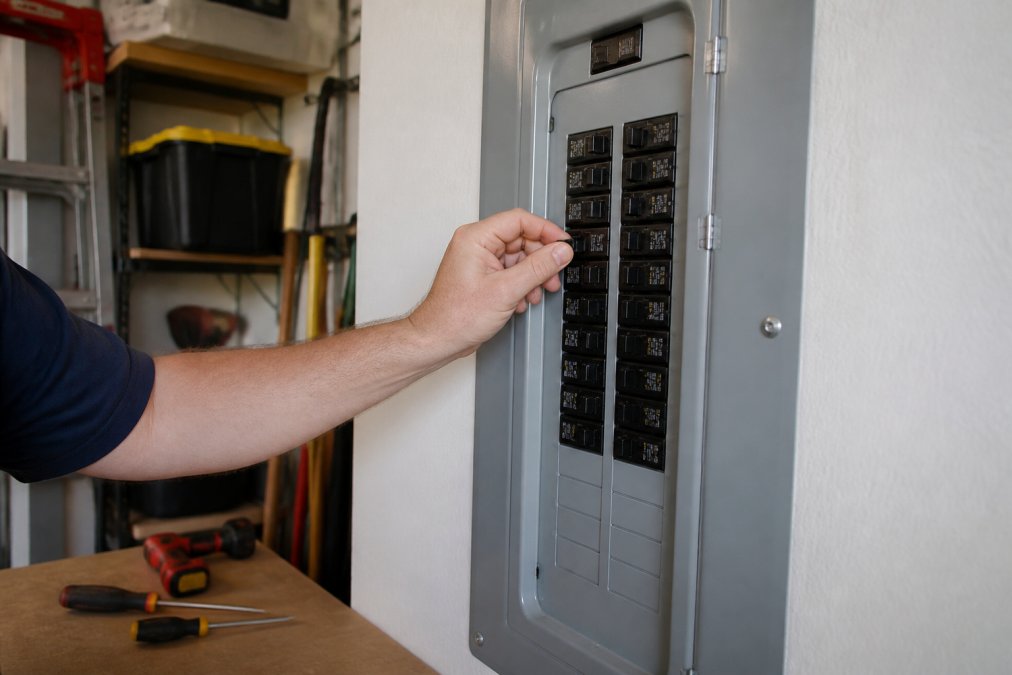
Step by step:
- Locate the electrical panel and identify the tripped breaker handle
- Unplug or switch off everything on that circuit
- Push the handle firmly to OFF, then to ON
- Restore devices one at a time, pausing between each
- If it trips again during step 4, stop. You’ve found your problem device or a wiring fault
Never hold a breaker handle in the ON position to force it to stay. Breakers trip for a reason, and defeating that mechanism can overheat the service panel wiring. If a breaker won’t reset at all, it may have failed internally, and that’s an electrician’s call.
Signs of a Bad Circuit Breaker You Shouldn’t Ignore
A bad breaker shows physical evidence before it fails completely. Look for a handle that feels loose or won’t stay in position, a scorched or discolored casing, a burning smell near the breaker box, or a breaker that’s warm to the touch when the circuit is idle.
Visual identification is where most homeowners fall short. You don’t need a multimeter for the first pass, just a flashlight and a few minutes.
Check for:
- Discoloration or melting around the breaker body
- Rust or moisture inside the panel
- A breaker that trips within seconds of resetting
- Buzzing or crackling with the circuit on
Any of these point to a breaker, a connection, or a bus bar problem that needs professional diagnosis, not another reset.
A breaker that feels hot when nothing on the circuit is running is a red flag most people miss. Heat with no load means resistance somewhere in the circuit, and resistance means a fire risk you can’t see.
When to Call an Electrician for a Tripped Breaker
Call an electrician for a tripped breaker when it trips repeatedly, trips without any load on the circuit, or shows physical damage. Those three patterns separate a nuisance trip from a hazard, and they’re the point where DIY resetting becomes unsafe.
The “random” trip phenomenon deserves its own mention. A breaker that trips at unpredictable intervals, sometimes days apart, often points to an intermittent arc fault or a loose connection that heats and cools with use. These are the hardest to diagnose and the most likely to be ignored until something fails.
Reach out to a licensed professional when:
- The same breaker trips three or more times in a week
- A ground fault or arc fault breaker trips with nothing plugged in
- You smell burning near the panel
- The panel is warm, buzzing, or shows rust
Fox Electric Technologies handles panel diagnostics and panel upgrades for homes and businesses that have outgrown their original service. If your electrical panel is still running on a 100-amp service with modern loads, repeated trips may be a capacity problem, not a breaker problem.
AFCI vs. GFCI Breakers: What’s the Difference?
An AFCI breaker protects against arc faults, the sparking that starts fires inside walls. A GFCI breaker protects against ground faults, the shock risk when current escapes through water or a person. They solve different problems, and modern electrical code often calls for both.
Here’s the distinction that trips people up: a GFCI will not catch a series arc behind drywall, and an AFCI will not catch a shock hazard in a wet bathroom. That’s why kitchens, baths, garages, and laundry areas typically need GFCI protection, while living spaces and bedrooms benefit from AFCI protection.
| Breaker Type | Protects Against | Typical Locations | Trips When |
|---|---|---|---|
| Standard | Overload, short circuit | General circuits | Current exceeds rating |
| GFCI | Ground faults, shock | Kitchen, bath, garage, exterior | Current leaks to ground |
| AFCI | Arc faults, fire | Bedrooms, living areas | Arc signature detected |
| Dual-function | Both arc and ground faults | Whole-home coverage | Either fault detected |
The NEC standards have expanded AFCI and GFCI requirements over successive code cycles, which is why older panels often lack protection that current code expects. If your panel predates those requirements, an upgrade may be the honest answer.
The diagnostic difference most guides skip
When a breaker trips, the first question is not “what caused it”, it is “which breaker tripped, and what does that tell me?” AFCI and GFCI breakers fail for different reasons, and the reset behavior narrows the cause fast.
If a GFCI breaker or receptacle trips:
- The device is sensing current leaving the circuit through an unintended path. That path is usually water, a damaged appliance, or a person.
- Unplug everything on the circuit and reset. If it holds, add devices back one at a time. A single appliance that trips it every time has an internal ground fault and should be replaced, not reset around.
- If it trips with nothing plugged in, moisture or a damaged conductor is the likely cause.
If an AFCI breaker trips:
Why this matters for older panels
Label your panel. When a breaker trips, knowing whether it is a standard, GFCI, AFCI, or dual-function breaker tells you what to check first and roughly how long the diagnosis will take. A panel with no labeling turns a five-minute check into an hour of guessing.
Electrical safety foundation guidance on AFCI and GFCI protection
Common Mistakes Homeowners Make When Breakers Trip
Other errors we see regularly:
The pattern of trips matters more than any single trip. One trip under heavy load is normal. Repeated trips, trips with no load, or trips that smell like burning are the signals that separate a reset from a repair.
Conclusion: When to Stop Resetting and Start Repairing
Frequently Asked Questions
How do you fix a breaker that keeps tripping?
Start by unplugging everything on that circuit and resetting the breaker. If it holds, plug devices back in one at a time until it trips again; that identifies the culprit. If the breaker trips with nothing plugged in, the problem is in the wiring or the breaker itself. Repeated tripping means the circuit is overloaded or there is a fault, and an electrician should inspect it.
How many times can a breaker trip before it goes bad?
There is no fixed number. A breaker is designed to trip repeatedly, but each trip causes slight internal wear. Most residential breakers handle hundreds of trips over their lifespan, yet frequent tripping from overloads or faults accelerates degradation. If your breaker trips weekly or monthly, the constant stress will shorten its life and it should be evaluated by a licensed electrician.
Is it dangerous if a circuit breaker trips frequently?
Yes. Frequent tripping signals an overloaded circuit, a short circuit, a ground fault, or failing equipment. Ignoring it can lead to overheating, melted wiring insulation, or an electrical fire. The breaker is doing its job by cutting power. If it trips more than once a month, stop resetting it and have a professional diagnose the cause.
Can a circuit breaker be bad and not be tripped?
Yes. A breaker can fail internally while the handle stays in the ON position, meaning it no longer trips when it should. Signs include flickering lights on that circuit, a burning smell near the panel, or the breaker feeling hot to the touch. A multimeter can test continuity, but only a licensed electrician should confirm whether the breaker needs replacement.
