
Table of Contents
- What Drives the Cost of a 200 Amp Panel Upgrade in 2026
- Signs You Need a 200 Amp Service Upgrade
- Electrical Panel Upgrade Permit Requirements
- How Long Does a Panel Upgrade Take?
- What’s Included in a 200 Amp Service Upgrade
- EV Chargers, Heat Pumps, and Smart Panels: Modern Load Demands
- Frequently Asked Questions
Last Updated: September 16, 2026
What Drives the Cost of a 200 Amp Panel Upgrade in 2026
The cost of a 200 amp panel upgrade in 2026 depends on four variables: your home’s existing amperage capacity, the condition of the service entrance conductors and meter socket, local labor rates, and whether the utility provider needs to modify its side of the connection. Two identical houses on the same street can receive quotes that differ by thousands of dollars for exactly this reason. The sticker price is never random. It reflects real scope differences that most quotes don’t explain.
A 200 amp panel is an electrical service panel rated to distribute up to 200 amps of current across the circuits in a home. It replaces older 60-amp or 100-amp panels that cannot support modern appliance loads, EV chargers, or heat pumps without tripping.
The single biggest cost driver is whether the upgrade is a straightforward panel replacement or a full service change. A panel replacement swaps the box and breakers. A service change also replaces the meter socket, the service mast, and the conductors running from the utility drop to the panel. The second is significantly more labor and material.
Amperage Capacity: 100A vs 200A vs 400A
Amperage capacity determines how much electrical load your home can carry at once. A 100-amp service handles a gas-powered home with standard appliances. A 200-amp service supports electric ranges, dryers, central air, and one or two EV chargers. A 400-amp service is for large homes or properties with heavy simultaneous demand.
| Service Size | Typical Home | Supports EV Charger? | Relative Cost |
|---|---|---|---|
| 100A | Small, gas appliances | Usually no | Lowest |
| 200A | Average modern home | Yes, one or two | Moderate |
| 400A | Large or all-electric home | Yes, multiple | Highest |
Most homeowners upgrading from 100 amps land on 200 amps because it covers current needs with headroom for future additions. Jumping straight to 400 amps only makes sense when a load calculation shows genuine demand.
Labor Rates and Material Costs
Labor typically makes up the larger share of a panel upgrade quote, and it varies by region, season, and the complexity of the existing wiring. Material costs cover the panel itself, circuit breakers, the meter socket, grounding and bonding components, and service entrance conductors.
What most guides miss is that the panel hardware is rarely the expensive part. The cost lives in the labor hours required to bring everything up to current electrical code, especially in older homes where the existing work doesn’t meet modern standards. A common mistake is comparing quotes on the panel brand alone. The real difference between a low quote and a high one is usually how much remediation labor each contractor has priced in.
A suspiciously low quote often excludes permit fees, utility coordination, or code corrections discovered during inspection. That gap gets billed later, after the wall is already open.
Signs You Need a 200 Amp Service Upgrade
The clearest signs you need a 200 amp service upgrade are breakers that trip repeatedly under normal load, lights that flicker when large appliances start, a panel with no spare breaker slots, and any plan to add an EV charger or heat pump. These aren’t cosmetic annoyances. They signal that your power distribution is running at or past its safe limit.
Tripping Breakers and Flickering Lights
Tripping breakers and flickering lights are the two most common symptoms homeowners notice first. A breaker that trips once during a storm is normal. A breaker that trips every time the microwave and toaster run together is telling you the circuit, or the whole service, is overloaded.
Flickering lights across multiple rooms point to voltage drop at the service level rather than a single bad circuit. That’s a service capacity problem, not a wiring problem, and it won’t resolve with a new breaker.
Other warning signs worth taking seriously:
- A fuse box or panel with fuses instead of circuit breakers
- Rust, scorch marks, or a burning smell near the panel
- A 60-amp or 100-amp main breaker with no room to expand
- Knob-and-tube wiring still feeding part of the home
- A panel manufactured by a brand with known safety recalls
The U.S. Consumer Product Safety Commission maintains recall information on electrical components, and it’s worth checking your panel’s brand before assuming a replacement is optional.
If two or more of these apply, get a load calculation before you spend money on anything else.
Electrical Panel Upgrade Permit Requirements
Electrical panel upgrade permit requirements vary by jurisdiction, but nearly every authority having jurisdiction requires a permit for a service change. The permit exists to trigger an inspection that confirms your new panel meets the adopted electrical code, which in most jurisdictions is a state or local adoption of the National Electrical Code published by the National Fire Protection Association. Skipping the permit creates a paper trail problem when you sell, and it can give an insurer grounds to deny a fire claim tied to the panel.
What the Inspection Actually Checks
A service change inspection is not a rubber stamp. The inspector is verifying specific code requirements, including:
- Working clearance in front of the panel, which the code sets at a minimum depth and width so a person can service the panel safely.
- Grounding and bonding, including the grounding electrode conductor, the connection to the grounding electrode system, and bonding of metal water piping and gas piping where required.
- Service entrance conductor sizing matched to the overcurrent device and the calculated load.
- Overcurrent protection ratings and breaker compatibility with the panel listing.
- Labeling of the service disconnect and panel schedule.
A rough inspection typically happens before the panel is closed up, so the inspector can see the wiring and grounding. A final inspection happens after the panel is energized and all circuits are terminated. Some jurisdictions combine these into a single inspection for a straightforward residential swap, and some require both.
Utility-Side vs. Customer-Side Costs
This is the split most quotes gloss over, and it is where homeowners get surprised. The customer-side work is what your electrician controls: the panel, breakers, meter socket, service mast, service entrance conductors, grounding, and the permit and inspection coordination. The utility-side work is what your provider controls: the service drop or lateral, the meter itself, and any transformer upgrade needed to support the new load.
If the utility determines that its transformer or service drop cannot support a 200-amp service, that work is scheduled and billed on the utility side, often as a separate line item or a contribution-in-aid-of-construction charge.
The Permit Sequence
- Apply for the permit with your local building department, submitting the panel specs and a load calculation.
- Schedule a rough inspection before the panel is closed up, so the inspector can see the wiring and grounding.
- Coordinate with the utility provider to disconnect and reconnect power, which is often a separate fee and schedule.
- Pass the final inspection once the panel is energized and all circuits are terminated.
- Receive the inspection sign-off, which you keep for your records and future resale.
Ask your electrician for the permit number before work starts. A contractor who resists pulling a permit is telling you something about how the rest of the job will go. You can usually verify the permit status directly with your local building department.
How Long Does a Panel Upgrade Take?
A panel upgrade typically takes one to two days of on-site work for a standard residential service change, plus waiting time for the permit and the utility disconnect and reconnect. The on-site portion is fast. The scheduling around it is what stretches the calendar.
Here’s how the timeline usually breaks down:
| Phase | Typical Duration | Who Controls It |
|---|---|---|
| Permit application and approval | Several business days | Local building department |
| Utility disconnect scheduling | Varies by provider | Utility provider |
| On-site panel work | One to two days | Electrician |
| Rough and final inspection | Scheduled within days | Inspector |
| Utility reconnect | Varies by provider | Utility provider |
What’s Included in a 200 Amp Service Upgrade
A 200 amp service upgrade includes the new panel and main breaker, all branch circuit breakers, the meter socket, the service mast and weatherhead, new service entrance conductors, grounding and bonding to current code, and the permit and inspection coordination. It also includes the load calculation that justifies the 200-amp rating in the first place.
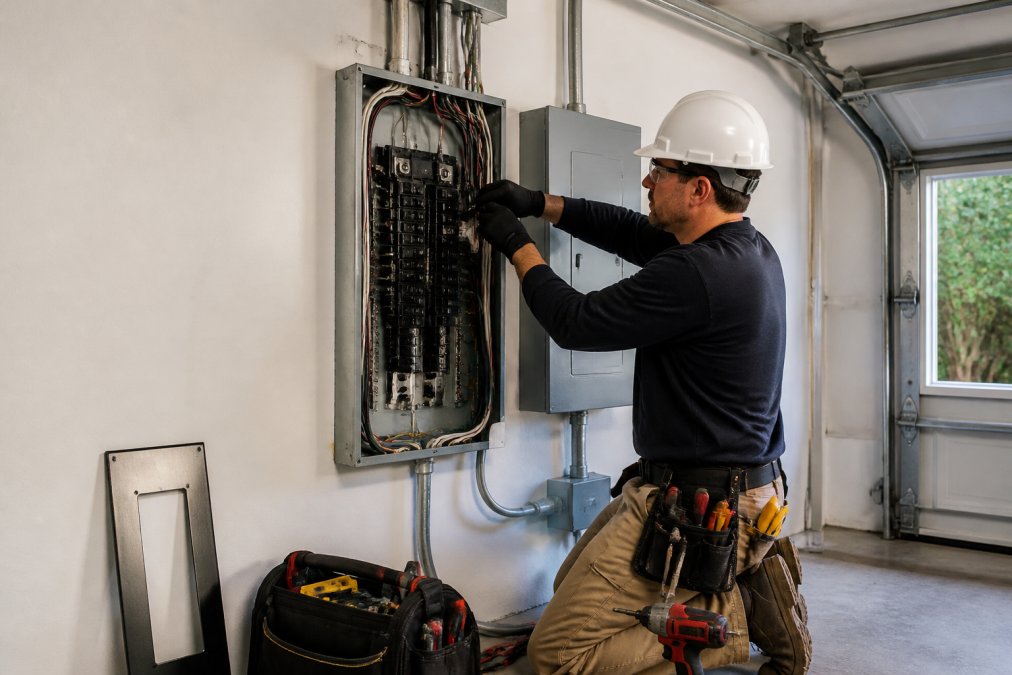
Before comparing quotes, confirm whether each one includes permit fees, utility coordination, and code remediation. Quotes that omit these aren’t cheaper. They’re incomplete.
EV Chargers, Heat Pumps, and Smart Panels: Modern Load Demands
Modern load demands are the main reason 200-amp service has become the default rather than an upgrade. A single Level 2 EV charger can draw as much continuous current as an electric range, and a heat pump adds another large continuous load. Add those to an existing 100-amp service and you’re past capacity before you plug anything in.
Frequently Asked Questions
How much should a 200 amp panel upgrade cost?
The cost of a 200 amp panel upgrade varies based on labor rates, material costs, permit fees, and whether utility-side work is needed. Factors like home age, existing wiring condition, and regional pricing all affect the total. Fox Electric Technologies provides transparent, upfront pricing based on your specific situation. Request a free estimate to get an accurate figure for your home.
Do you need a permit to upgrade to 200 amp service?
Yes, electrical panel upgrade permit requirements almost always apply. Most jurisdictions require a permit before work begins, followed by an inspection to confirm NEC compliance. Skipping the permit can lead to failed inspections, insurance issues, and costly rework. A licensed electrician will handle the permit application and schedule the inspection as part of the project.
Is it worth it to upgrade to 200 amp service?
A 200 amp service upgrade is worth it if you’re adding high-draw appliances, an EV charger, a heat pump, or finishing a basement. Modern homes with electrification upgrades often exceed 100-amp capacity. Upgrading improves safety, reduces tripping breakers, and supports future electrical needs. It can also add resale value and satisfy insurance or code requirements.
How long does a 200 amp panel installation typically take?
Most 200 amp panel installations take one to two days for the on-site work. However, the full timeline, including permit approval, utility coordination, and inspection, usually runs one to three weeks. If a service mast replacement or meter socket upgrade is needed, add extra time. Your electrician will provide a realistic schedule after assessing your setup.
